In plain English
Making a peptide uses a lot of solvent. Solvents dissolve the reagents, wash the resin the peptide is built on, and carry the peptide through purification [3, 4, 9]. Drying removes most of them, but never all. What is left behind is called a residual solvent.
Residual solvents add nothing useful. Some are harmless at the levels normally found. Others are toxic enough that international guidance sets firm limits on them in medicines [1].
The main guideline is ICH Q3C, written by the International Council for Harmonisation (ICH, the organisation that writes shared technical rules for medicine regulators). It puts each common solvent into one of three classes and gives a limit for the ones that matter most [1].
The short version
- Residual solvents are leftovers from manufacture that drying does not fully remove [1].
- ICH Q3C groups solvents into Class 1 (avoid), Class 2 (limit) and Class 3 (low toxic potential) [1].
- Solvents common in peptide work, such as DMF, dichloromethane and acetonitrile, are Class 2 [1, 4].
- Gas chromatography is the usual test [7, 8].
What counts as a residual solvent?
ICH Q3C defines residual solvents as organic volatile chemicals that are used or produced in the manufacture of drug substances or excipients, or in the preparation of finished products, and that are not completely removed by practical manufacturing techniques [1]. The guideline does not cover solvents deliberately added as excipients, or solvates (crystal forms that include solvent molecules) [1].
Two principles run through it. Because residual solvents serve no purpose in the final product, they should be removed to the extent possible. And testing is only needed for solvents that are actually used or produced in manufacture or purification [1]. A certificate of analysis that reports residual solvents therefore needs the manufacturer’s process knowledge behind it: an analyst has to know which solvents to look for.
Water is not a residual solvent in this sense. It is measured separately, usually by Karl Fischer titration. See Water Content and Karl Fischer Titration.
Where residual solvents come from in peptide manufacture
Solid-phase peptide synthesis (SPPS) builds a peptide one amino acid at a time on a resin bead, with deprotection, coupling and washing steps repeated for every residue [3]. Each step uses solvent, and the washes use the most.
- Synthesis. DMF (N,N-dimethylformamide), dichloromethane and NMP (N-methylpyrrolidone) are the most common solvents in peptide synthesis [4]. European peptide guidance notes that SPPS requires extensive washing of the resin with solvents, and that the removal (“purge”) of every reagent and solvent should be shown by data or risk analysis [3].
- Purification. A 1984 account of preparative reversed-phase HPLC for more than 300 synthetic peptides used mobile phases that included acetonitrile and 0.1% trifluoroacetic acid (TFA) [12].
- Drying. Some freeze-drying processes use an organic co-solvent such as tert-butyl alcohol. In one study, residual tert-butyl alcohol depended mostly on the physical state of the dried solid: crystalline glycine kept 0.01–0.03%, while amorphous sucrose kept about 100 times more [10]. In another, drying a polymer from 70% tert-butanol at high shelf temperatures left 7.7% residual solvent [11].
The scale is large. A survey of 40 synthetic peptide processes from 14 companies found an average process mass intensity of about 13,000 for SPPS, meaning roughly 13,000 kg of materials used per kg of peptide. The authors linked this to the excess solvents and reagents that SPPS uses [5]. DMF is also under regulatory pressure in its own right: the European Chemicals Agency classifies it as a substance of very high concern because of reproductive toxicity, and restrictions on its use have been introduced [6]. Reviews of “greener” peptide synthesis describe efforts to replace DMF, dichloromethane and NMP [4, 6]. A change of solvent changes which residual solvents a laboratory needs to test for. See How Peptides Are Made.
How ICH Q3C classifies solvents
ICH Q3C places solvents into three classes based on a toxicological risk assessment [1]:
| Class | Meaning in ICH Q3C | Examples | How the limit is set |
|---|---|---|---|
| Class 1 | Solvents to be avoided, because of unacceptable toxicity or harmful environmental effects | Benzene (2 ppm), carbon tetrachloride (4 ppm), 1,2-dichloroethane (5 ppm) | A fixed concentration limit, used only if the solvent truly cannot be avoided |
| Class 2 | Solvents to be limited, because of inherent toxicity | Acetonitrile, DMF, dichloromethane, methanol, NMP, tetrahydrofuran, toluene | A permitted daily exposure (PDE) in mg per day, with a matching concentration in ppm |
| Class 3 | Solvents with low toxic potential | Acetic acid, acetone, ethanol, ethyl acetate, ethyl ether, tert-butyl methyl ether, 2-propanol, DMSO | 50 mg per day or less, equal to 5,000 ppm (0.5%), is acceptable without justification |
A fourth table lists solvents for which no adequate toxicological data were found, so no PDE could be set. It includes trifluoroacetic acid, isopropyl ether and petroleum ether. Manufacturers should justify the residual levels of these solvents [1].
The TFA entry matters for peptides. European peptide guidance lists residual TFA content as a specification test in its own right, separate from residual solvents [3]. It can be measured, for example, by ion chromatography, which can detect trifluoroacetate below 90 ng/mL [13]. See Counter-Ions in Peptides.
Class 2 limits for solvents common in peptide work
The PDE is the maximum acceptable intake of a residual solvent per day from a pharmaceutical product [1]. Q3C turns each PDE into a concentration limit (“Option 1”) by assuming 10 g of product per day:
Concentration (ppm) = 1000 × PDE (mg/day) ÷ 10 (g/day)
So acetonitrile, with a PDE of 4.1 mg/day, has an Option 1 limit of 410 ppm [1]. A second route (“Option 2”) uses the real maximum daily amount of the finished product instead of 10 g, and sums the solvent contributed by every ingredient [1]. Option 2 only makes sense for a defined finished medicine.
The Option 1 limits for Class 2 solvents relevant to peptide synthesis and purification are [1]:
| Solvent | Typical role in peptide work | PDE (mg/day) | Option 1 limit (ppm) |
|---|---|---|---|
| Acetonitrile | HPLC purification [12] | 4.1 | 410 |
| Dichloromethane | Resin swelling and washes [4] | 6.0 | 600 |
| N,N-Dimethylformamide (DMF) | Coupling and washes [4] | 8.8 | 880 |
| N-Methylpyrrolidone (NMP) | Coupling and washes [4] | 5.3 | 530 |
| Tetrahydrofuran | Process solvent | 7.2 | 720 |
| Methanol | Process solvent | 30.0 | 3,000 |
| Tertiary-butyl alcohol | Freeze-drying co-solvent [10] | 35 | 3,500 |
A conversion that helps with certificates: 1 ppm is 1 µg per g, or 0.0001% by mass. So 410 ppm is 0.041% w/w and 5,000 ppm is 0.5% w/w.
How residual solvents are measured
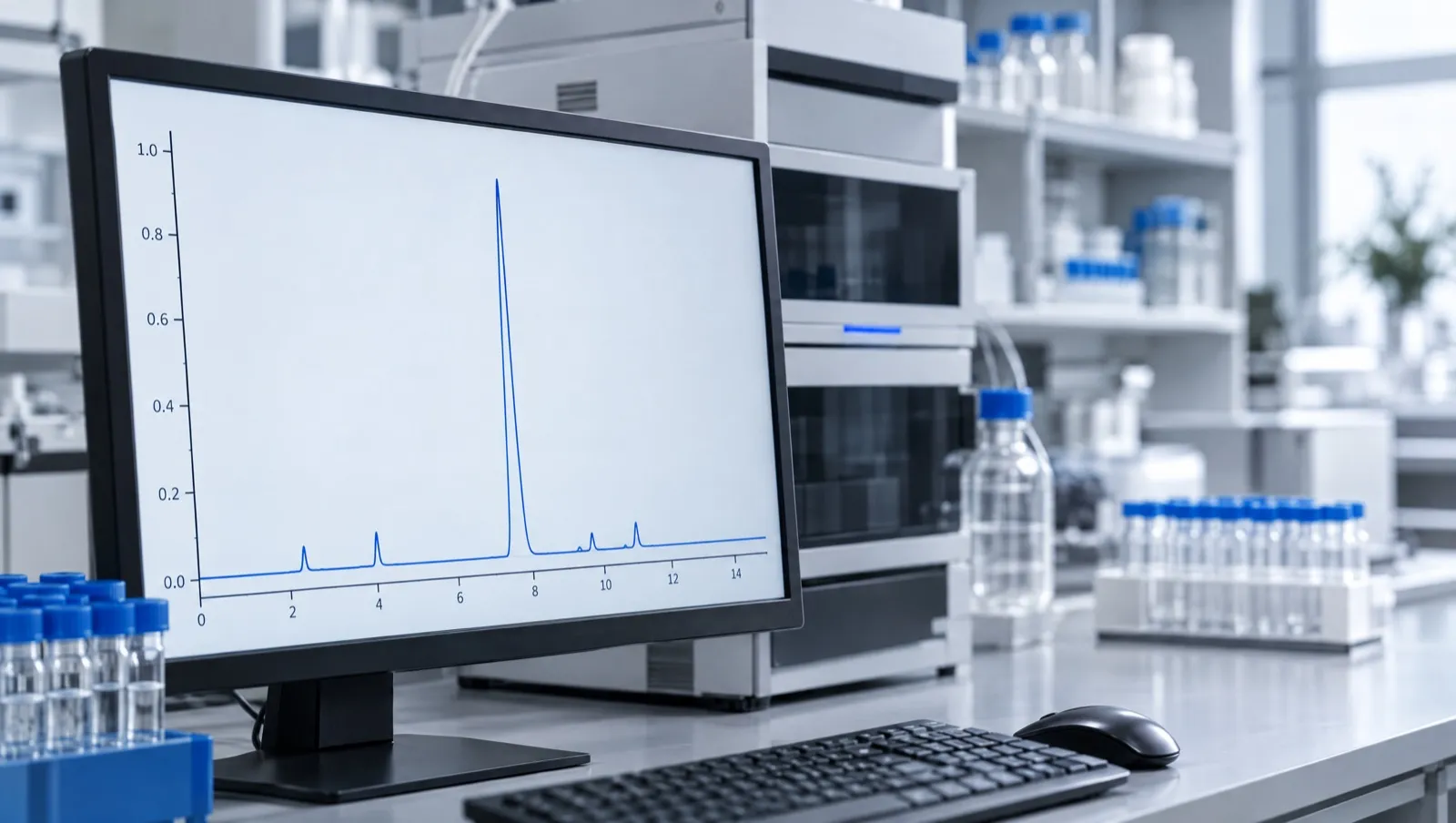
Gas chromatography (GC) is the chief method for residual solvents, generally preferred because it identifies each solvent specifically [7]. The sample can be introduced in several ways: static or dynamic headspace, solid-phase microextraction, or direct introduction of a dissolved sample into the chromatograph [7, 8].
Static headspace GC works like this. The sample is dissolved or suspended in a sealed vial and heated, and a portion of the vapour above it (the headspace) is sampled into the GC. Non-volatile material, such as the peptide itself, stays in the vial. The United States Pharmacopeia (USP) general chapter <467> uses static headspace GC with a flame ionisation detector; its procedures for water-insoluble samples dissolve the sample in DMSO or DMF before analysis [9]. GC with mass spectrometry (GC-MS) adds identification by mass. In a metrology institute’s purity assignment of a synthetic peptide, volatile organic compounds were measured by headspace GC-MS as one part of the mass balance [14].
Q3C adds three rules about methods [1]:
- Harmonised pharmacopoeial procedures should be used if feasible; otherwise a suitable validated method can be chosen.
- If only Class 3 solvents are present, a non-specific method such as loss on drying may be used, if properly validated.
- Validation should follow ICH Q2, and the R9 revision added that the effect of solvent volatility on the method should be considered. See Analytical Method Validation.
Loss on drying has an obvious weakness for peptides: it cannot tell water from solvent. Peptides are often very hygroscopic powders [3], so a loss-on-drying result mixes their water content with any solvent present.
Reading a residual-solvent result: a worked example
ICH Q3C gives examples of statements a supplier could make about residual solvents, such as “only Class 2 solvents X, Y… are likely to be present; all are below the Option 1 limit”, or “only Class 3 solvents are likely to be present; loss on drying is less than 0.5%”. “Likely to be present” means the solvent used in the final step plus any earlier solvent not consistently removed by a validated process. Class 1 solvents that are likely to be present should be identified and quantified [1].
The figures below are illustrative, for one batch of a lyophilised synthetic peptide tested by headspace GC.
| Solvent | Class | Result (ppm) | Q3C limit (ppm) | Within the Q3C benchmark? |
|---|---|---|---|---|
| Acetonitrile | 2 | 180 | 410 | Yes |
| DMF | 2 | 40 | 880 | Yes |
| Dichloromethane | 2 | Not detected (< 30) | 600 | Yes |
| Ethyl ether | 3 | 1,200 | 5,000 | Yes |
| Acetic acid | 3 | Not reported here; measured as counter-ion | 5,000 | See counter-ion result |
Points worth checking on a real certificate:
- The solvent list matches the process. A synthesis that used NMP should report NMP. A list that names only ethanol for an SPPS product raises a question.
- Limits of detection are stated. “Not detected” means little without the method’s detection limit.
- Units are clear. ppm (µg/g) and % w/w differ by a factor of 10,000.
- The method is named. Headspace GC-FID or GC-MS, with the pharmacopoeial chapter if one was followed.
- The result belongs to the batch. Residual solvent depends on drying conditions, so a result from another batch does not transfer [10, 11].
In a mass balance, residual solvents are usually a small term. In the illustrative batch above, the detected solvents add up to 1,420 ppm, or about 0.14% w/w. See Purity vs Peptide Content and Peptide Impurities.
Why residual solvents matter in the laboratory
Most residual solvents in a well-dried peptide are present at low levels, but they still matter for research work:
- Mass. Solvent adds mass that is not peptide, so it is one of the terms subtracted when peptide content is calculated by mass balance [14].
- Experimental artefacts. A 2026 review noted that residual solvents can affect a material’s properties and its biological activity in in vitro and ex vivo models [15].
- Process consistency. A sudden change in the residual-solvent profile between batches can signal a change in the manufacturing process.
What this means in Australia
- Adopted guidance. The TGA adopted ICH Q3C(R8) on 26 June 2024, with no Australian annotations [2]. The EMA’s current version is R9, which came into effect in the EU on 29 April 2024 and made a minor change on method validation [1].
- Scope. Q3C applies to medicines. It does not apply to products during the clinical research stages of development, nor to existing marketed products [1]. For a research chemical it is a benchmark for reading a certificate, not a legal requirement.
- Peptide-specific expectations. European guidance for synthetic peptide medicines lists residual solvents among the tests a specification may include, and expects residual solvents to comply with Q3C thresholds or be toxicologically qualified [3].
- Research-use labels. The TGA has stated that a “research use only” disclaimer does not make supply lawful, change a product’s regulatory status, permit importation, or remove advertising or supply obligations [16]. A residual-solvent result describes one batch; it does not change any of this.
This is general information, not legal advice. Laws change; check the current Poisons Standard and TGA guidance.
Frequently asked questions
What are residual solvents?
Organic volatile chemicals used or produced during manufacture that practical techniques do not completely remove [1].
What are the three ICH Q3C classes?
Class 1 solvents should be avoided, Class 2 solvents should be limited because of their inherent toxicity, and Class 3 solvents have low toxic potential [1].
What is the ICH Q3C limit for acetonitrile?
Acetonitrile is Class 2, with a PDE of 4.1 mg per day and an Option 1 concentration limit of 410 ppm [1].
Is trifluoroacetic acid covered by ICH Q3C?
It is listed among solvents with no adequate toxicological data, so Q3C gives no PDE for it and residual levels need justification [1]. In peptides, TFA is usually measured as a counter-ion [13].
How are residual solvents tested?
Usually by gas chromatography, often with static headspace sampling and a flame ionisation or mass spectrometric detector [7, 9].
References
- European Medicines Agency. ICH Q3C (R9) Guideline on impurities: guideline for residual solvents. Step 5. EMA/CHMP/ICH/82260/2006. April 2024. ema.europa.eu. Accessed 25 October 2026.
- Therapeutic Goods Administration. ICH guideline Q3C (R8) on impurities: guideline for residual solvents. International scientific guidelines adopted in Australia. tga.gov.au. Accessed 25 October 2026.
- European Medicines Agency. Guideline on the development and manufacture of synthetic peptides. EMA/CHMP/CVMP/QWP/367182/2025. Adopted 4 December 2025; effective 1 June 2026. ema.europa.eu. Accessed 25 October 2026.
- Varnava KG, Sarojini V. Making solid-phase peptide synthesis greener: a review of the literature. Chem Asian J. 2019;14(8):1088–1097. doi:10.1002/asia.201801807. PMID: 30681290
- Kekessie I, Wegner K, Martinez I, et al. Process mass intensity (PMI): a holistic analysis of current peptide manufacturing processes informs sustainability in peptide synthesis. J Org Chem. 2024;89(7):4261–4282. doi:10.1021/acs.joc.3c01494. PMID: 38508870
- Scognamiglio A, Magli E, Caliendo G, et al. Once upon a time without DMF: greener paths in peptide and organic synthesis. Molecules. 2026;31(3):536. doi:10.3390/molecules31030536. PMID: 41683514
- B’Hymer C. Residual solvent testing: a review of gas-chromatographic and alternative techniques. Pharm Res. 2003;20(3):337–344. doi:10.1023/a:1022693516409. PMID: 12669951
- Grodowska K, Parczewski A. Analytical methods for residual solvents determination in pharmaceutical products. Acta Pol Pharm. 2010;67(1):13–26. PMID: 20210075
- Belsky JL, Ashley AJ, Bhatt PA, et al. Optimization of the water-insoluble procedures for USP General Chapter Residual Solvents <467>. AAPS PharmSciTech. 2010;11(2):994–1004. doi:10.1208/s12249-010-9460-6. PMID: 20521178
- Wittaya-Areekul S, Nail SL. Freeze-drying of tert-butyl alcohol/water cosolvent systems: effects of formulation and process variables on residual solvents. J Pharm Sci. 1998;87(4):491–495. doi:10.1021/js9702832. PMID: 9548903
- Kunz C, Schuldt-Lieb S, Gieseler H. Freeze-drying from organic co-solvent systems, part 2: process modifications to reduce residual solvent levels and improve product quality attributes. J Pharm Sci. 2019;108(1):399–415. doi:10.1016/j.xphs.2018.07.002. PMID: 30017885
- Rivier J, McClintock R, Galyean R, Anderson H. Reversed-phase high-performance liquid chromatography: preparative purification of synthetic peptides. J Chromatogr. 1984;288(2):303–328. doi:10.1016/s0021-9673(01)93709-4. PMID: 6736144
- Kaiser E, Rohrer J. Determination of residual trifluoroacetate in protein purification buffers and peptide preparations by ion chromatography. J Chromatogr A. 2004;1039(1–2):113–117. doi:10.1016/j.chroma.2004.03.044. PMID: 15250411
- Wang S, Wu P, Li M, et al. Mass balance method for SI-traceable purity assignment of synthetic oxytocin. J Pharm Biomed Anal. 2022;207:114401. doi:10.1016/j.jpba.2021.114401. PMID: 34656934
- Guerassimoff L, Nicolas J. Towards safer medicines: management of residual solvents and green alternatives. J Control Release. 2026;391:114643. doi:10.1016/j.jconrel.2026.114643. PMID: 41558557
- Therapeutic Goods Administration. Understanding your responsibilities when importing, compounding and supplying unapproved peptide products. Safety advisory, 13 April 2026. tga.gov.au. Accessed 25 October 2026.