In plain English
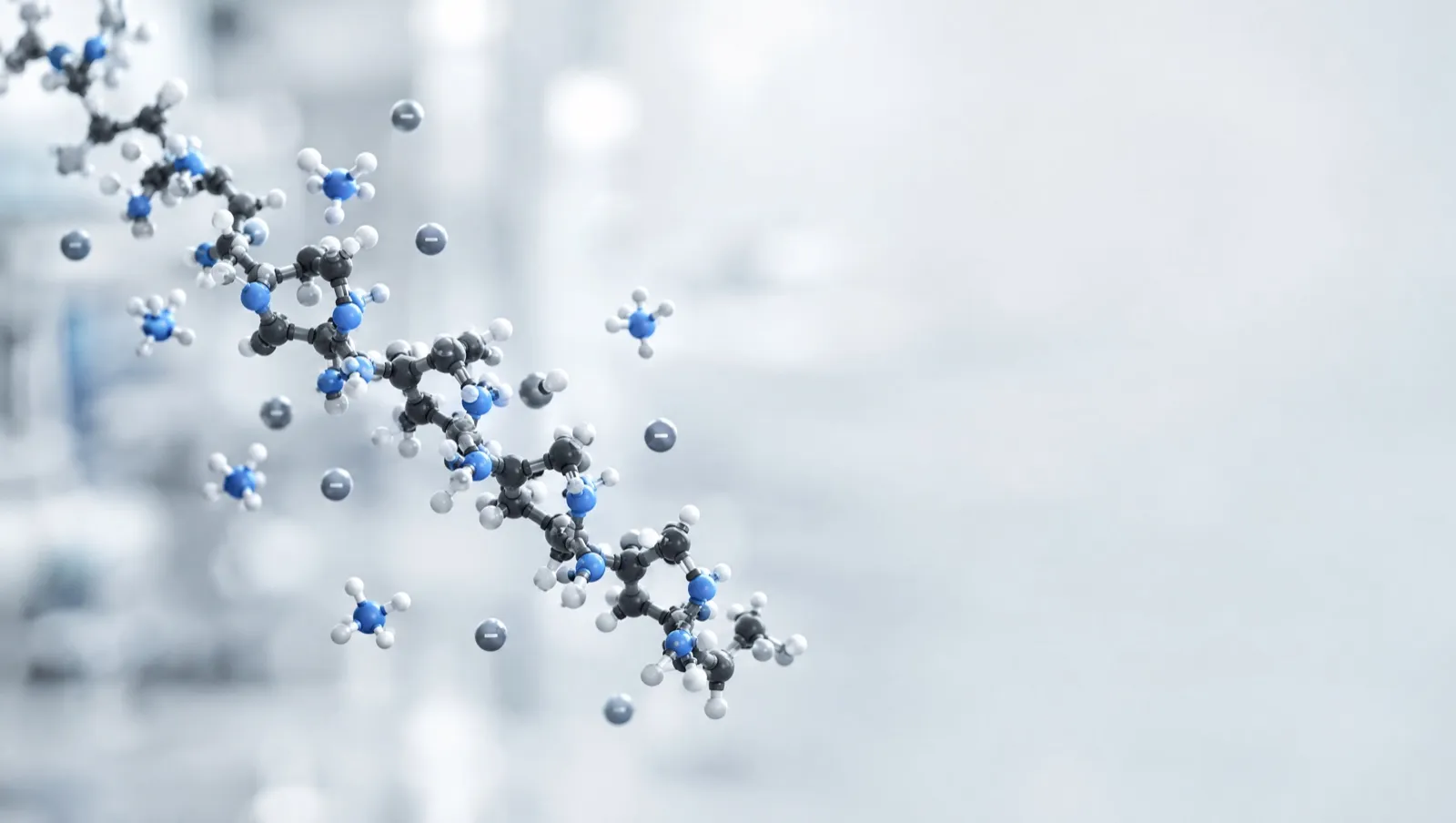
A synthetic peptide powder usually contains more than the peptide itself. Peptides carry positive electric charges, and each charge is paired with a small negative ion called a counter-ion. Together they form a salt, a bit like sodium and chloride in table salt [3].
The usual way of making peptides uses trifluoroacetic acid (TFA), so most peptides start out as TFA salts. Makers can swap TFA for acetate or chloride (from hydrochloric acid, HCl) [2, 4].
This has two practical effects:
- Weight. Counter-ions add weight that is not peptide, so a vial holds less peptide than its total powder weight [3, 4].
- Cell experiments. In rat bone and cartilage cells, very small amounts of TFA lowered cell growth in culture [1]. Other studies found that salt form changed results, but not always in the same direction [6, 7].
No single salt is best for every experiment [6]. In practice, it helps to know which counter-ion a batch contains and how much of it there is, and to keep it the same between batches.
What is a counter-ion, and why do peptides have one?
A peptide’s free N-terminus and basic side chains (lysine, arginine and histidine) carry positive charges under acidic conditions. Each positive charge is balanced by a negatively charged ion, the counter-ion. The peptide and its counter-ion together form a salt [3].
The amount of counter-ion depends on the sequence. A 2025 study found that counter-ion content was linked to sequence differences, especially the number of positive charges [4]. A peptide rich in arginine or lysine can therefore carry a substantial weight of counter-ion. This directly lowers its net peptide content (see Purity vs Peptide Content).
Where does TFA come from?
TFA is used at two stages of standard peptide manufacture [2, 4]:
- Cleavage. In Fmoc solid-phase synthesis, the finished peptide is released from the resin and deprotected with a TFA-based mixture.
- Purification. TFA is the usual ion-pairing additive in reversed-phase HPLC.
As a result, cationic peptides are mainly obtained as trifluoroacetate salts [2]. TFA can be present both bound to the peptide’s basic groups and as free acid adsorbed in the lyophilised powder [3]. See How Research Peptides Are Made.
TFA vs acetate vs HCl at a glance
| Trifluoroacetate (TFA) | Acetate | Chloride (HCl) | |
|---|---|---|---|
| Parent acid pKa (25 °C) | about 0.5 | about 4.8 | about −7 |
| How a peptide gets it | Default from cleavage and HPLC purification | Ion exchange, or purification with acetic acid | Repeated dissolution in dilute HCl and lyophilisation, or ion exchange |
| Use in approved peptide medicines | Some (e.g. bivalirudin) | Most common | Less common |
| Main concerns | Reported effects on cell assays; interferes with infrared spectroscopy | Generally preferred over TFA for biological work | Very acidic exchange conditions can degrade some peptides |
pKa values and use in medicines: Sikora et al. [3]. Exchange conditions: Roux et al. and Erckes et al. [2, 4].
According to a 2020 review, most approved peptide medicines are acetate salts. The reasons are partly TFA’s reported toxicity and partly history, since early purification methods produced acetates [3]. European guidance on synthetic peptides states that acetate is usually used, that other counter-ions such as trifluoroacetate or chloride are possible, and that the counter-ion “can affect the biological and physicochemical properties of the peptide.” It expects the counter-ion to be defined and its amount controlled [5].
Does TFA affect cell-based assays?
Yes. Several peer-reviewed studies have reported that the counter-ion can change results in vitro:
- Cell proliferation. In fetal rat osteoblast cultures, TFA at 10⁻⁸ to 10⁻⁷ M (10–100 nM) reduced cell numbers and thymidine incorporation after 24 hours. Similar effects were seen in articular chondrocytes and neonatal mouse calvariae. When TFA and hydrochloride salts of amylin, amylin-(1–8) and calcitonin were compared, the TFA salts consistently gave lower proliferation. This could mask a real proliferative effect or wrongly suggest an anti-proliferative one. The authors recommended converting peptides to a hydrochloride or equivalent salt before testing biological effects [1].
- Antimicrobial and cytotoxicity assays. Acetate, hydrochloride and TFA salts of five antimicrobial peptides were compared for antibacterial activity, red-cell haemolysis and cytotoxicity in a human keratinocyte line (HaCaT). There were substantial differences between salts, but no consistent pattern across peptides [6].
- Airway cell lines. The TFA salt of the antimicrobial peptide M33 was 5–30% more toxic than its acetate salt to cultured bronchial cells, although antibacterial activity was similar [7].
- Membrane permeability. In a liposome assay, passive membrane permeability changed with both peptide sequence and salt form (TFA vs chloride) [4].
- Other reported effects. A review notes reports of TFA acting as an allosteric modulator of glycine receptors at low concentrations, showing that its effects are not always inhibitory [3].
TFA also interferes with infrared spectroscopy of peptides, which complicates structural characterisation [2].
Not every TFA-salt peptide will give an artefact in every assay, but the counter-ion is an experimental variable. A recent study concluded that counter-ion quantification and specification are important in assays with synthetic peptides [4].
How is counter-ion content measured?
| Method | Measures | Source |
|---|---|---|
| ¹⁹F NMR | TFA (fluorine signal) | [2, 4] |
| FT-IR / ATR-IR | TFA; can monitor removal | [2, 4] |
| HPLC with evaporative light-scattering detection | TFA | [4] |
| Pharmacopoeial HPLC methods | TFA and acetic acid content | [8] |
| Ion chromatography (described as the first-choice technique) and capillary electrophoresis | TFA, chloride, acetate and other anions | [3] |
A 2025 study validated ¹⁹F NMR, FT-IR and HPLC-ELSD methods for residual TFA according to ICH guidelines [4]. The European Pharmacopoeia includes a general chapter on acetic acid in synthetic peptides [5].
How are counter-ions exchanged?
Three main approaches are described in the peer-reviewed literature:
- Repeated lyophilisation from dilute HCl. The peptide is dissolved in HCl, a stronger acid than TFA, and freeze-dried. The cycle is repeated several times. A review reports exchange efficiencies of up to about 98% after several repetitions, with traces of TFA often remaining [3]. A 2025 study found 10 mM HCl to be the optimal concentration, with no effect on peptide purity at any HCl concentration tested [4].
- Ion-exchange resin or reversed-phase HPLC with a different acid. These can partially or almost completely replace TFA with the anion of a weaker acid, such as acetate [2].
- Deprotonation and reprotonation. The peptide’s amino groups are deprotonated in basic solution, releasing TFA completely, then reprotonated with the chosen acid [2].
One study noted that the classical HCl method involves working below pH 1, which can degrade some peptides [2]. Every exchange step also adds handling, so the final material should be re-tested for purity and counter-ion content.
What to look for on a certificate of analysis
- Counter-ion identity: whether the material is a TFA, acetate or chloride salt.
- Counter-ion or residual TFA content, with the method.
- Net peptide content, which accounts for counter-ion weight.
European guidance lists counter-ion identity and content, and residual TFA, as separate specification tests for synthetic peptide medicines [5]. Research materials aren’t bound by that guidance, but the same information is useful when designing experiments. See How to Read a Peptide Certificate of Analysis.
What this means in Australia
- Peptides are therapeutic goods. Under the Therapeutic Goods Act 1989, peptide products are regulated as therapeutic goods in Australia. The TGA has warned that the labelling of unapproved peptide products may be inaccurate or misleading [9]. A label that omits the salt form or net peptide content leaves out information this guide describes as important.
- Labels don’t change status. The TGA has stated that a “research use only” disclaimer does not make supply lawful. It does not change a product’s regulatory status, permit importation, or remove advertising or supply obligations [9]. The TGA also counts applying a label to a blank vial as a step in manufacture [10].
- Scheduling is compound by compound. Changing the counter-ion does not change which substance a peptide is. Some research peptides are named in the current Poisons Standard (October 2026); for example, BPC-157 and TB-500 are Schedule 4 (prescription-only) and Appendix D, clause 5 (possessing them without authority is illegal) [11]. See Are Peptides Legal in Australia?.
- Laboratory accreditation. In Australia, NATA (the National Association of Testing Authorities) accredits testing laboratories to ISO/IEC 17025, the international standard for testing competence [12]. When reading a counter-ion or TFA result, it is worth checking whether the laboratory’s accreditation covers the method reported.
This is general information, not legal advice. Laws change; check the current Poisons Standard and TGA guidance.
Frequently asked questions
What is the difference between TFA and acetate peptide salts?
They differ only in the counter-ion paired with the peptide’s positive charges. TFA salts are the default product of standard synthesis and HPLC purification. Acetate salts are usually made by exchange and are the most common form among approved peptide medicines [2, 3].
Can TFA affect cell culture experiments?
It has been reported to. TFA at 10–100 nM reduced proliferation of rat osteoblasts and chondrocytes in culture, and TFA salts of several peptides gave lower proliferation than their hydrochloride salts [1].
How is TFA removed from peptides?
Common approaches are repeated lyophilisation from dilute HCl, ion-exchange resins, reversed-phase HPLC with a different acid, and deprotonation followed by reprotonation [2–4].
Does the counter-ion change a peptide’s purity?
Not its HPLC purity, which compares peptide species only. It does change net peptide content, because the counter-ion adds weight that isn’t peptide [3, 4].
Is HCl or acetate better than TFA?
It depends on the experiment. In one study of antimicrobial peptides, no single salt performed best across all peptides [6]. For experiments to be comparable, the counter-ion should be known, reported and consistent between batches.
References
- Cornish J, Callon KE, Lin CQ, et al. Trifluoroacetate, a contaminant in purified proteins, inhibits proliferation of osteoblasts and chondrocytes. Am J Physiol. 1999;277(5):E779–E783. doi:10.1152/ajpendo.1999.277.5.E779. PMID: 10567002
- Roux S, Zékri E, Rousseau B, Paternostre M, Cintrat JC, Fay N. Elimination and exchange of trifluoroacetate counter-ion from cationic peptides: a critical evaluation of different approaches. J Pept Sci. 2008;14(3):354–359. doi:10.1002/psc.951. PMID: 18035848
- Sikora K, Jaśkiewicz M, Neubauer D, Migoń D, Kamysz W. The role of counter-ions in peptides: an overview. Pharmaceuticals (Basel). 2020;13(12):442. doi:10.3390/ph13120442. PMID: 33287352
- Erckes V, Streuli A, Chamera Rendueles L, Krämer SD, Steuer C. Towards a consensus for the analysis and exchange of TFA as a counterion in synthetic peptides and its influence on membrane permeation. Pharmaceuticals (Basel). 2025;18(8):1163. doi:10.3390/ph18081163. PMID: 40872554
- European Medicines Agency. Guideline on the development and manufacture of synthetic peptides. EMA/CHMP/CVMP/QWP/367182/2025. Adopted 4 December 2025; effective 1 June 2026. ema.europa.eu. Accessed 11 October 2026.
- Sikora K, Jaśkiewicz M, Neubauer D, et al. Counter-ion effect on antistaphylococcal activity and cytotoxicity of selected antimicrobial peptides. Amino Acids. 2018;50(5):609–619. doi:10.1007/s00726-017-2536-9. PMID: 29307075
- Pini A, Lozzi L, Bernini A, et al. Efficacy and toxicity of the antimicrobial peptide M33 produced with different counter-ions. Amino Acids. 2012;43(1):467–473. doi:10.1007/s00726-011-1103-z. PMID: 21984381
- McCarthy D, Han Y, Carrick K, et al. Reference standards to support quality of synthetic peptide therapeutics. Pharm Res. 2023;40(6):1317–1328. doi:10.1007/s11095-023-03493-1. PMID: 36949371
- Therapeutic Goods Administration. Understanding your responsibilities when importing, compounding and supplying unapproved peptide products. Safety advisory, 13 April 2026. tga.gov.au. Accessed 11 October 2026.
- Therapeutic Goods Administration. Unapproved peptide product promoters and suppliers are put on notice. Media release, 20 July 2026. tga.gov.au. Accessed 11 October 2026.
- Commonwealth of Australia. Therapeutic Goods (Poisons Standard—October 2026) Instrument 2026 (F2026L01327). legislation.gov.au/F2026L01327/latest/text. Accessed 11 October 2026.
- National Association of Testing Authorities, Australia (NATA). Laboratory accreditation: ISO/IEC 17025. nata.com.au. Accessed 11 October 2026.
Important information and disclaimer
General information only. This article is published for general educational and informational purposes. It summarises published scientific literature and public regulatory information as at the “last reviewed” date shown above. It is not medical, health, pharmaceutical, veterinary or legal advice, and it must not be relied on as a substitute for advice from a qualified professional about your circumstances.
Not for human or animal use. Nothing in this article recommends, endorses or describes the use of any substance in humans or animals. Findings from cell, animal or early human studies cannot be assumed to apply to people. The compounds discussed have not been evaluated by the Therapeutic Goods Administration (TGA) for safety, quality or efficacy unless the article expressly states otherwise. Any research materials offered by Iconic Peptides are supplied solely for in vitro and laboratory research.
No therapeutic claims. Iconic Peptides makes no claim that any product treats, cures, prevents, alleviates or diagnoses any disease, condition or symptom. References to published studies, clinical trials or medicines approved by regulators are factual descriptions of the scientific and regulatory record. They are not representations about any product we supply.
Regulatory status. Many peptides are scheduled substances under the Poisons Standard. Some are prescription-only (Schedule 4), and some may not be possessed without authority (Appendix D). The TGA has stated that a “research use only” label does not make supply lawful, change a product’s regulatory status, or remove advertising or supply obligations. State and territory laws may also apply. You are responsible for knowing and complying with all laws that apply to you. Regulatory information in this article may change after the review date.
Accuracy and third-party sources. We take care to cite and verify every source, but we do not warrant that this article is complete, current or error-free. Citing a study or organisation does not mean that its authors or that organisation endorse Iconic Peptides.
Limitation of liability. To the maximum extent permitted by law, Iconic Peptides, its owners, employees and contributors exclude all liability for any loss, damage, injury or expense, whether direct, indirect or consequential, arising from use of or reliance on this article or any misuse of any product. Nothing in this disclaimer excludes, restricts or modifies any right or remedy under the Australian Consumer Law that cannot lawfully be excluded.
Age restriction. This website is intended for adults aged 18 and over.