In plain English
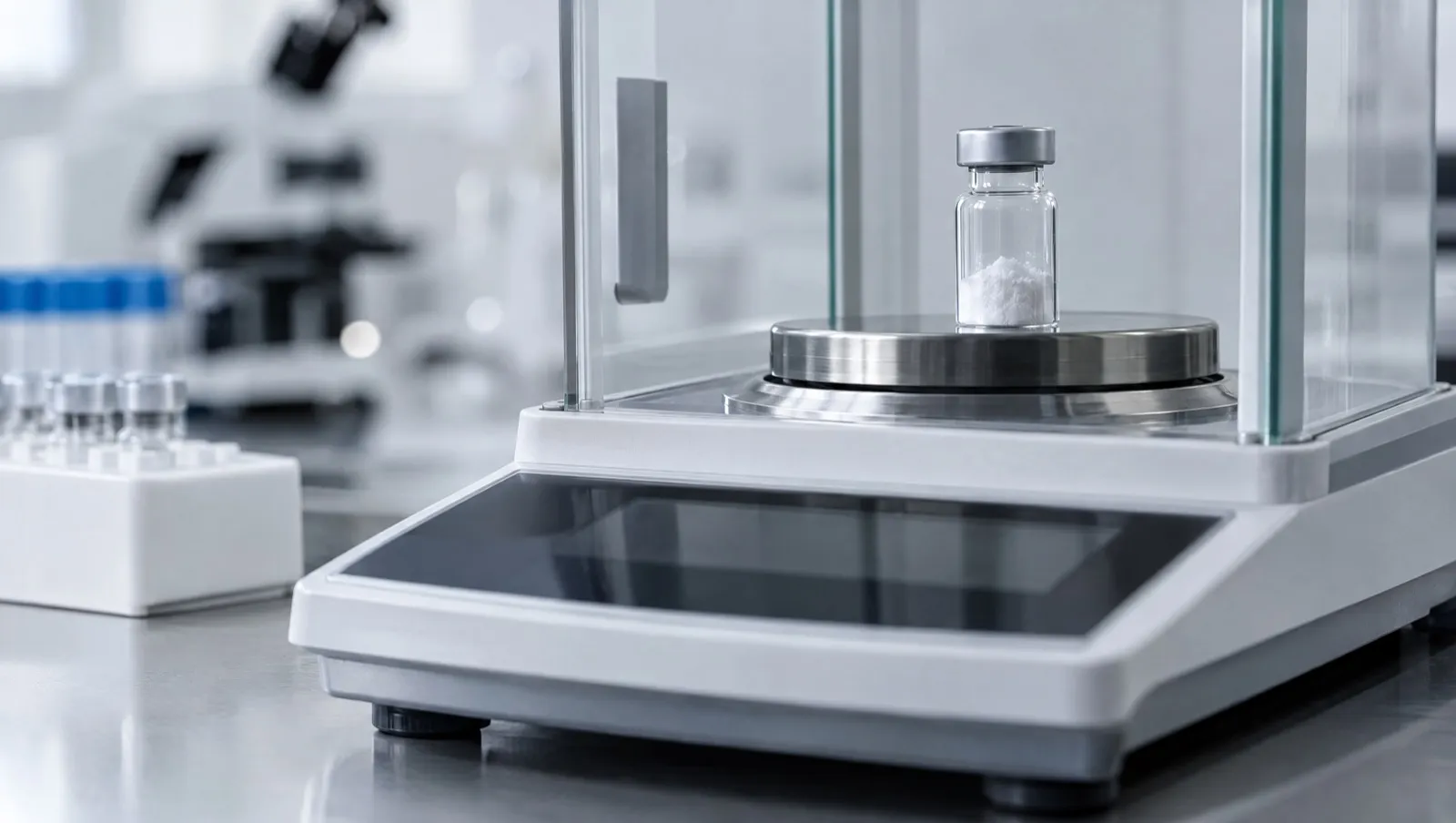
A peptide powder is not all peptide. Two numbers describe it, and they answer different questions.
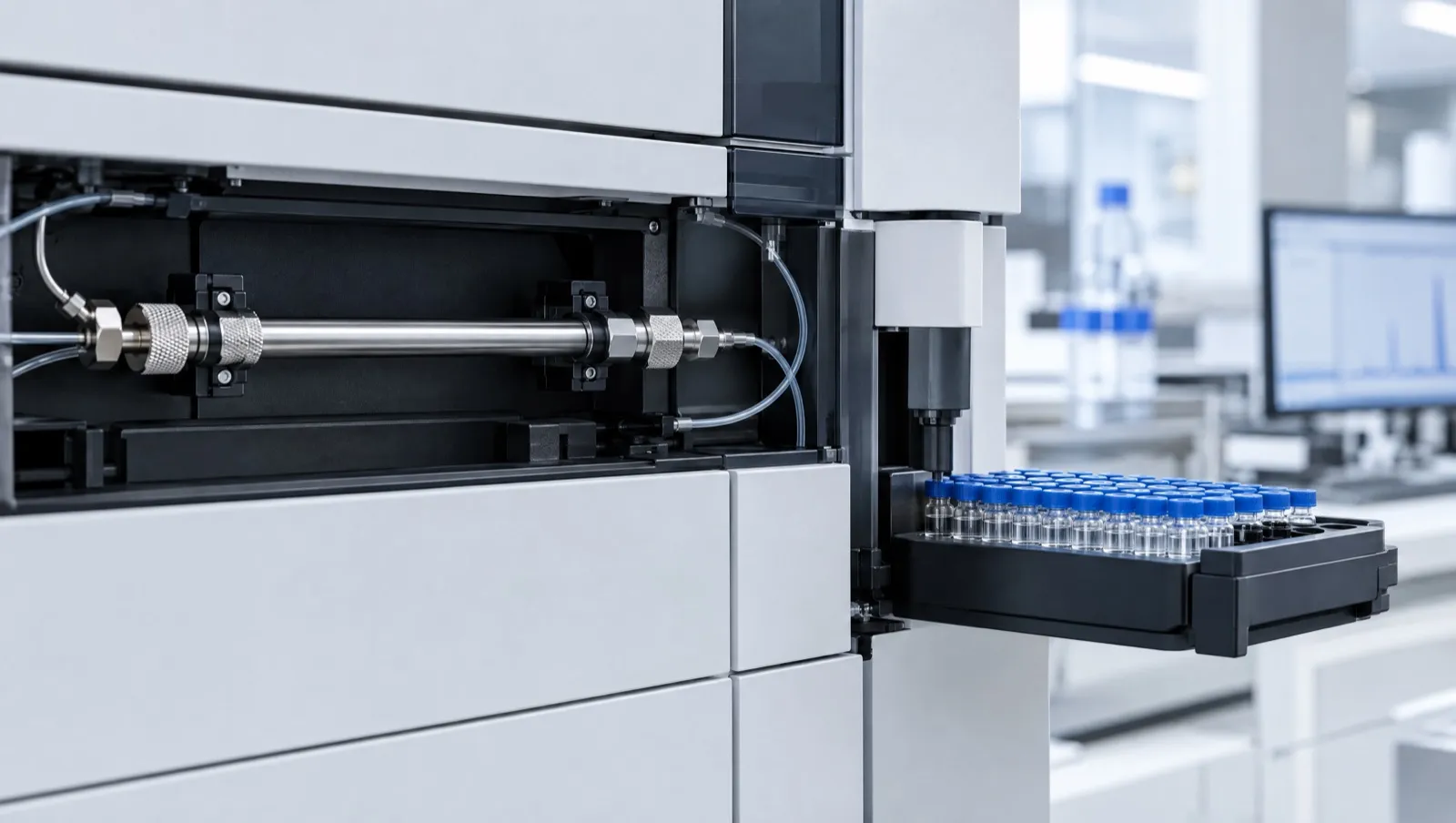
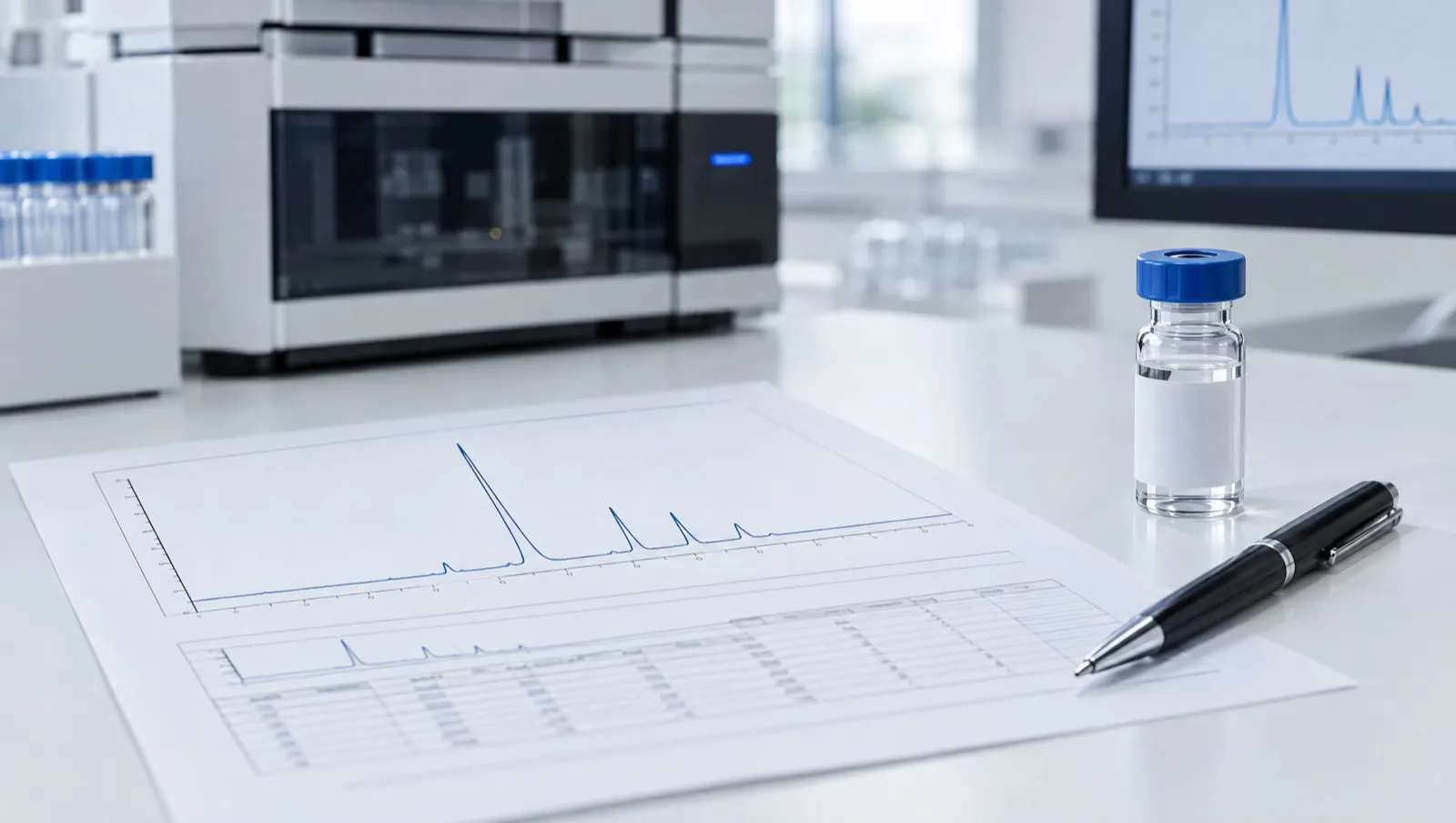
Purity asks: of the peptide material, how much is the right chain of amino acids (the building blocks of proteins)? It is usually measured by HPLC (a method that separates the parts of a sample) [1].
Net peptide content asks: of the whole powder’s weight, how much is peptide? The rest is mostly water and counter-ions (small charged molecules, such as acetate, that stick to the peptide) [1, 2].
So a powder can be 99% pure and still be only around 90% peptide by weight. In one worked example from a pharmacopoeia (an official book of drug standards), about 8–9% of the weight was not peptide [1]. In the lab, a solution made up from the powder’s weight alone will hold less peptide than expected.
The short version
- Purity and peptide content are different numbers.
- Water and counter-ions lower the content, not the purity.
- A “10 mg” label can mean 10 mg of powder or 10 mg of peptide.
- A good certificate of analysis says which [2].
Two numbers, two questions
| Purity | Net peptide content | |
|---|---|---|
| Question answered | Of the peptide material, how much is the correct sequence? | Of the total powder weight, how much is peptide? |
| Typical method | Reversed-phase HPLC (UV detection) | Amino acid analysis, HPLC assay against a reference standard, qNMR, nitrogen analysis |
| Units | % of total peak area | % w/w, or mg of peptide per mg of powder |
| Sees water and counter-ions? | No | Yes; they are what lower it |
Pharmacopoeial practice keeps these figures apart. In value assignment for peptide reference standards, HPLC impurities are measured as a percentage of chromatographic peak area. Counter-ions, residual solvents and inorganic residue are measured as percentages by weight. Water is accounted for separately [1].
What else is in a “pure” peptide powder?
A lyophilised synthetic peptide is rarely 100% peptide by weight. The main non-peptide components are:
- Counter-ions. Most peptides carry positively charged groups (the N-terminus and basic residues such as lysine and arginine). These are balanced by negatively charged counter-ions. Synthesis and purification usually leave peptides as trifluoroacetate (TFA) salts unless the counter-ion is exchanged, often for acetate or chloride [3, 4]. The amount depends on the sequence. Peptides with more positive charges carry more counter-ion [4]. See Counter-Ions in Peptides: TFA vs Acetate vs HCl.
- Water. Lyophilised peptides can be hygroscopic, meaning they absorb moisture from the air. European guidance asks manufacturers to describe hygroscopicity and to include water content in stability testing for hygroscopic powders [2].
- Residual solvents and inorganic residue. Small amounts can remain from synthesis and purification. They are measured separately, for example by gas chromatography and residue on ignition [1].
European guidance lists water content, counter-ion content, residual TFA and residual solvents as separate specification tests, alongside purity and assay [2].
A worked example from pharmacopoeial practice
A 2023 paper from the United States Pharmacopeia (USP) and the UK medicines regulator set out a theoretical mass-balance calculation for a peptide supplied as an acetate salt [1]:
| Component | Result |
|---|---|
| Sum of HPLC peptide impurities | 0.92% of peak area |
| Acetic acid (counter-ion) | 5.58% w/w |
| Trifluoroacetic acid | 0.003% w/w |
| Residual solvents | 0.003% w/w |
| Residue on ignition | 0.00% w/w |
| Peptide content (anhydrous basis) | 0.93 mg of peptide per mg of material |
| Peptide content after correcting for 1.5–2% water | 0.91–0.92 mg/mg |
Even in this well-controlled example, about 8–9% of the powder’s weight was not peptide. Counter-ion and water levels vary between peptides and batches. Peptides with many basic residues, or those left as TFA salts, can carry a larger non-peptide fraction [4].
Why “10 mg” needs a basis
A vial label of “10 mg” can mean two different things:
- 10 mg of powder (gross weight). If net peptide content is 80%, the vial holds about 8 mg of peptide.
- 10 mg of peptide (net content). The powder in the vial then weighs more than 10 mg.
These figures are illustrative only. The actual value depends on the batch. In regulated medicines the convention is explicit. European guidance says assay limits are expressed on a counter-ion-free, anhydrous basis, and that product strength is stated as the mass of peptide base, not including the salt or counter-ion [2]. Research material has no equivalent rule, so a certificate of analysis (COA) should say which basis it uses.
How is net peptide content measured?
| Method | How it works | Strengths and limits |
|---|---|---|
| Amino acid analysis (AAA) | The peptide is hydrolysed with 6 M HCl at about 110 °C for 20–24 hours. The released amino acids are then quantified [5]. | Accurate absolute quantity, usually better than 5%. Tryptophan is destroyed, cysteine is lost unless derivatised, and asparagine and glutamine are converted to aspartic and glutamic acid [5]. |
| HPLC assay against a reference standard | The sample’s main peak is compared with a well-characterised standard of known content [1, 6]. | Lowest inter-laboratory variability for oxytocin in a multi-lab study. Depends on the standard’s assigned value [6]. |
| Quantitative NMR (qNMR) | Peptide signals are measured against an internal standard of known purity [6]. | Direct measurement; simpler and faster to run. Proposed as a primary method worth further evaluation [6]. |
| Mass balance | Water, counter-ions, solvents, inorganic residue and peptide impurities are each measured and subtracted from 100% [1]. | Comprehensive, but every component must be measured. |
| Nitrogen or elemental analysis | Peptide quantity is calculated from measured nitrogen [2]. | Listed as an acceptable assay approach in European guidance [2]. |
| UV absorbance | Concentration is estimated from absorbance at 280 nm or 205 nm [7]. | Quick, but can’t distinguish the target peptide from related impurities. |
In a multi-laboratory study run with USP and several national regulators, including Australia’s Therapeutic Goods Administration, HPLC assay, qNMR and AAA were compared for the nonapeptide oxytocin. The HPLC assay using the same bulk material as its standard gave the lowest inter-laboratory variability [6].
When purity and content diverge in practice
A 2024 study analysed semaglutide vials bought from online sellers whose labels claimed 99% purity. Measured purity was 7.7–14.37%. Measured semaglutide content exceeded the labelled amount by 28.56–38.69%. Endotoxin was found in every sample [8]. Because the two figures moved in opposite directions, a single “purity” number could not describe what was in these vials.
Why it matters in the laboratory
Net peptide content affects every calculation that starts from a weighed or labelled mass:
- Stock concentrations. If a solution is made up on the assumption that the gross powder weight is all peptide, the true peptide concentration will be lower than calculated.
- Comparisons between batches. Two batches with identical HPLC purity can differ in water or counter-ion content, so equal weights may not contain equal amounts of peptide [1, 4].
- Counter-ion effects. The non-peptide fraction is not always inert. TFA in particular has been reported to affect some cell-based assays [3].
What a COA should show
- Purity by a named method (usually HPLC), with the chromatogram.
- Net peptide content or assay, with the method stated (for example, AAA or HPLC assay).
- Whether the labelled amount refers to gross powder weight or peptide content.
- Ideally, water content (for example, Karl Fischer titration) and counter-ion identity and content.
For a full walk-through, see How to Read a Peptide Certificate of Analysis and How Peptide Purity Is Actually Measured.
What this means in Australia
- Peptides are therapeutic goods. Peptide products are regulated as therapeutic goods under the Therapeutic Goods Act 1989. Unapproved peptide products are not on the ARTG (the Australian Register of Therapeutic Goods) and have not been assessed by the TGA for safety, quality or effectiveness [10].
- The TGA has flagged labelling. The TGA has warned that the labelling of unapproved peptide products may be inaccurate or misleading [10]. It also counts applying a label to a blank vial as a step in manufacture [11]. The TGA itself took part in the multi-laboratory peptide quantification study described above [6].
- Medicines are made under GMP. Manufacturers of therapeutic goods generally need a licence, and good manufacturing practice (GMP) applies. The TGA sums up GMP as: quality cannot be tested into a batch; it must be built in at every stage of manufacture [12].
- Scheduling is compound by compound. Some research peptides are named in the Poisons Standard. For example, BPC-157 and TB-500 are Schedule 4 (prescription-only) and Appendix D, clause 5 (possessing them without authority is illegal) [9].
- “Research use only” labels. The TGA has stated that a “research use only” disclaimer does not make supply lawful. It does not change a product’s regulatory status, permit importation, or remove advertising or supply obligations [10].
- Laboratory accreditation. In Australia, NATA accredits testing laboratories to ISO/IEC 17025. The standard covers method validity, staff competence, traceability of measurements, equipment calibration, quality control and reporting of results [13].
This is general information, not legal advice. Laws change; check the current Poisons Standard and TGA guidance.
Frequently asked questions
What is net peptide content?
Net peptide content is the percentage of a peptide powder’s total weight that is peptide. The remainder is mainly water and counter-ions, with traces of solvents and other residues [1, 2].
Why is net peptide content lower than purity?
Purity compares the target peptide only with other peptide species. Content compares it with everything in the powder, including water and counter-ions that HPLC purity doesn’t count [1].
How is net peptide content measured?
Common methods are amino acid analysis after acid hydrolysis, HPLC assay against a reference standard, and quantitative NMR. Mass balance and nitrogen analysis are also used [1, 2, 5, 6].
Does a “10 mg” vial contain 10 mg of peptide?
Not necessarily. It depends on whether the label refers to gross powder weight or to net peptide content. The COA should state which [2].
Do counter-ions affect peptide content?
Yes. Counter-ions add weight without adding peptide. Their amount depends on the counter-ion and on how many positively charged groups the sequence has [4].
References
- McCarthy D, Han Y, Carrick K, et al. Reference standards to support quality of synthetic peptide therapeutics. Pharm Res. 2023;40(6):1317–1328. doi:10.1007/s11095-023-03493-1. PMID: 36949371
- European Medicines Agency. Guideline on the development and manufacture of synthetic peptides. EMA/CHMP/CVMP/QWP/367182/2025. Adopted 4 December 2025; effective 1 June 2026. ema.europa.eu. Accessed 11 October 2026.
- Sikora K, Jaśkiewicz M, Neubauer D, Migoń D, Kamysz W. The role of counter-ions in peptides: an overview. Pharmaceuticals (Basel). 2020;13(12):442. doi:10.3390/ph13120442. PMID: 33287352
- Erckes V, Streuli A, Chamera Rendueles L, Krämer SD, Steuer C. Towards a consensus for the analysis and exchange of TFA as a counterion in synthetic peptides and its influence on membrane permeation. Pharmaceuticals (Basel). 2025;18(8):1163. doi:10.3390/ph18081163. PMID: 40872554
- Højrup P. Analysis of polypeptides by amino acid analysis. Methods Mol Biol. 2024;2821:71–82. doi:10.1007/978-1-0716-3914-6_6. PMID: 38997481
- Li C, Bhavaraju S, Thibeault MP, et al. Survey of peptide quantification methods and comparison of their reproducibility: a case study using oxytocin. J Pharm Biomed Anal. 2019;166:105–112. doi:10.1016/j.jpba.2018.12.028. PMID: 30640042
- Anthis NJ, Clore GM. Sequence-specific determination of protein and peptide concentrations by absorbance at 205 nm. Protein Sci. 2013;22(6):851–858. doi:10.1002/pro.2253. PMID: 23526461
- Ashraf AR, Mackey TK, Vida RG, et al. Multifactor quality and safety analysis of semaglutide products sold by online sellers without a prescription: market surveillance, content analysis, and product purchase evaluation study. J Med Internet Res. 2024;26:e65440. doi:10.2196/65440. PMID: 39509151
- Therapeutic Goods (Poisons Standard—October 2026) Instrument 2026 (F2026L01327). Federal Register of Legislation. legislation.gov.au. Accessed 11 October 2026.
- Therapeutic Goods Administration. Understanding your responsibilities when importing, compounding and supplying unapproved peptide products. Safety advisory, 13 April 2026. tga.gov.au. Accessed 11 October 2026.
- Therapeutic Goods Administration. Unapproved peptide product promoters and suppliers are put on notice. Media release, 20 July 2026. tga.gov.au. Accessed 11 October 2026.
- Therapeutic Goods Administration. Good manufacturing practice (GMP); and Manufacturing. tga.gov.au; tga.gov.au. Accessed 11 October 2026.
- National Association of Testing Authorities, Australia (NATA). Laboratory accreditation: ISO/IEC 17025. nata.com.au. Accessed 11 October 2026.
Important information and disclaimer
General information only. This article is published for general educational and informational purposes. It summarises published scientific literature and public regulatory information as at the “last reviewed” date shown above. It is not medical, health, pharmaceutical, veterinary or legal advice, and it must not be relied on as a substitute for advice from a qualified professional about your circumstances.
Not for human or animal use. Nothing in this article recommends, endorses or describes the use of any substance in humans or animals. Findings from cell, animal or early human studies cannot be assumed to apply to people. The compounds discussed have not been evaluated by the Therapeutic Goods Administration (TGA) for safety, quality or efficacy unless the article expressly states otherwise. Any research materials offered by Iconic Peptides are supplied solely for in vitro and laboratory research.
No therapeutic claims. Iconic Peptides makes no claim that any product treats, cures, prevents, alleviates or diagnoses any disease, condition or symptom. References to published studies, clinical trials or medicines approved by regulators are factual descriptions of the scientific and regulatory record. They are not representations about any product we supply.
Regulatory status. Many peptides are scheduled substances under the Poisons Standard. Some are prescription-only (Schedule 4), and some may not be possessed without authority (Appendix D). The TGA has stated that a “research use only” label does not make supply lawful, change a product’s regulatory status, or remove advertising or supply obligations. State and territory laws may also apply. You are responsible for knowing and complying with all laws that apply to you. Regulatory information in this article may change after the review date.
Accuracy and third-party sources. We take care to cite and verify every source, but we do not warrant that this article is complete, current or error-free. Citing a study or organisation does not mean that its authors or that organisation endorse Iconic Peptides.
Limitation of liability. To the maximum extent permitted by law, Iconic Peptides, its owners, employees and contributors exclude all liability for any loss, damage, injury or expense, whether direct, indirect or consequential, arising from use of or reliance on this article or any misuse of any product. Nothing in this disclaimer excludes, restricts or modifies any right or remedy under the Australian Consumer Law that cannot lawfully be excluded.
Age restriction. This website is intended for adults aged 18 and over.