In plain English
A test result is only as good as the method behind it. Validation (checking a method before relying on it) means running planned experiments to show that the method measures what it claims, correctly and repeatably, across the range that matters [1].
For a peptide purity test, that means showing the method can tell the peptide apart from its impurities, gives the right answer on samples of known content, and gives the same answer when repeated by another analyst on another day [1].
Two international guidelines for medicines describe this. ICH Q2(R2) covers validation. ICH Q14 covers how methods are developed and how sensitive they are to small changes in conditions [1, 2].
Validation is done once, and again after major changes. A quick check called system suitability is run every time the method is used [2, 3].
The short version
- Validation shows a method is fit for one stated purpose [1].
- Different tests need different evidence [1].
- System suitability is checked every run [3].
- A certificate rarely shows validation data, but it should name the method.
What validation is, and why it matters
ICH Q2(R2) states the objective plainly: to demonstrate that an analytical procedure is fit for its intended purpose [1]. The guideline applies to release and stability testing of commercial medicines, and its principles can be applied in a “phase-appropriate” way during development [1].
A validation study follows a written plan prepared beforehand, stating the intended purpose, the characteristics to be tested and the acceptance criteria. The results go into a validation report [1]. The experiments should use the same number of replicates as routine testing, and they should use reference materials of documented identity and purity [1]. See Reference Standards Explained.
Earlier versions of ICH Q2, and US Food and Drug Administration (FDA) guidance, call the properties being tested “validation characteristics” [1, 4]. The ICH guidelines harmonised their definitions, but the analyst still has to choose which ones matter for a given method and set acceptance criteria that fit the specification limits [5]. A 2003 review described FDA, USP and ICH requirements for validating HPLC methods as three overlapping sets that had left industry confused [6].
The validation characteristics in ICH Q2(R2)
| Characteristic | Question it answers | Typical evidence in ICH Q2(R2) [1] |
|---|---|---|
| Specificity / selectivity | Do other substances interfere? | No interference from impurities, degradation products or matrix; comparison with an orthogonal method; or a technology-based justification, such as isotope resolution in mass spectrometry |
| Working range | Over what interval is the method reliable? | Suitable response, accuracy and precision from the lowest to the highest result reported |
| Response (linearity) | Is the signal proportional to the amount? | At least five concentrations; slope, intercept, correlation coefficient and a residual plot |
| Accuracy | Is the answer close to the true value? | Comparison with a reference material, accuracy from spiked samples, or an orthogonal method |
| Precision | How much do repeated results scatter? | Repeatability, intermediate precision and, where relevant, reproducibility |
| Detection and quantitation limits | What is the smallest amount seen, and measured? | Visual evaluation, signal-to-noise, or the standard deviation of the response and the slope |
Specificity
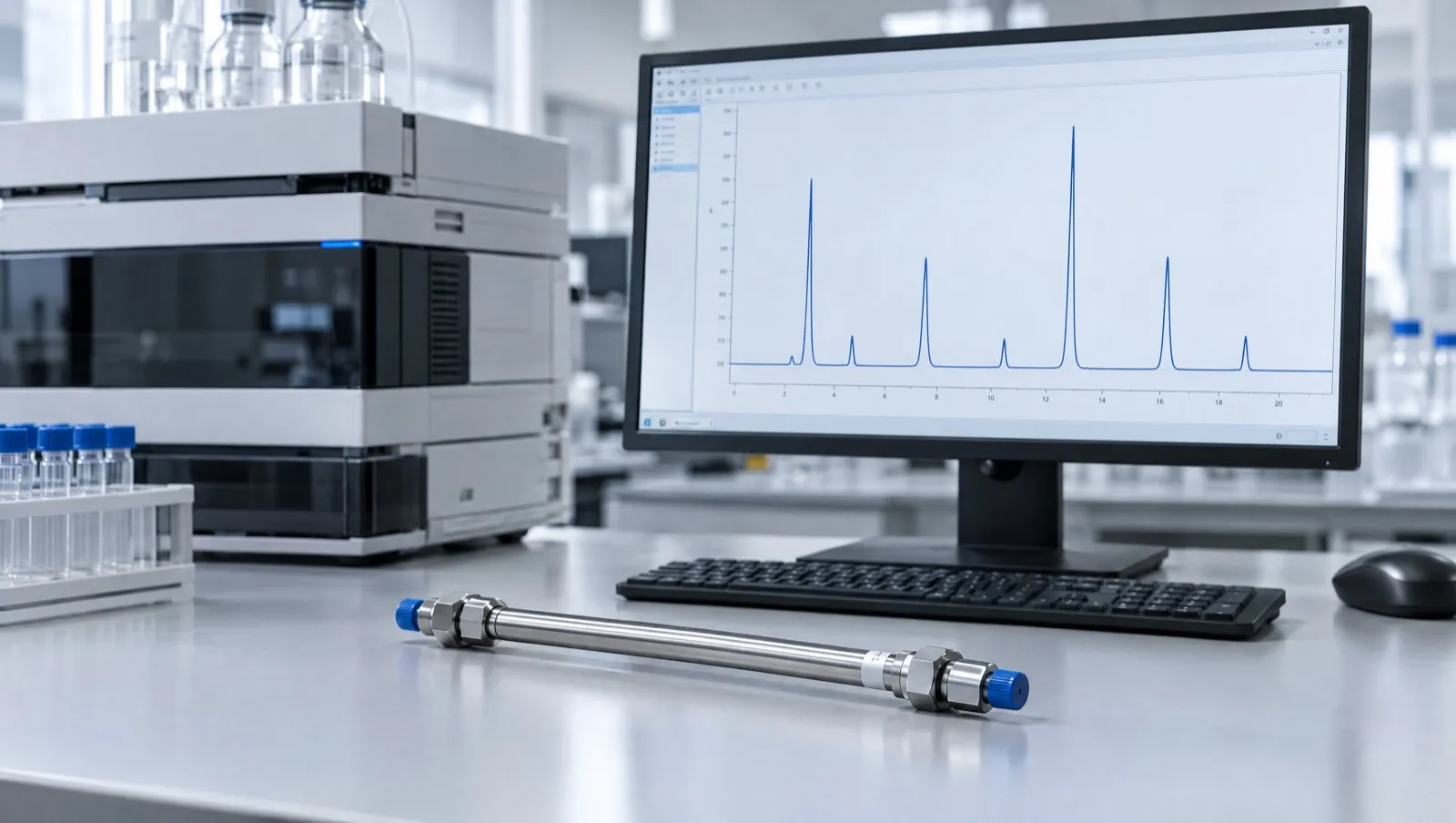
For chromatography, specificity can be shown by the resolution of the two components that elute closest together [1]. For an identity test, the method should give a positive result with the analyte and a negative result with closely related materials [1]. A stability-indicating method must also separate degradation products, shown with stressed or aged samples [1]. If one method is not specific enough, ICH Q2(R2) recommends combining two or more [1].
Range and response
Ranges are tied to the use. ICH Q2(R2) gives examples: an assay from 80% to 120% of the declared content; an impurity test from the reporting threshold to 120% of the specification limit; and purity by area % from 80% of the lower specification limit up to the upper limit or 100% [1]. Non-linear responses are acceptable when modelled properly; S-shaped concentration–response curves, for example, are often fitted with four- or five-parameter logistic functions [1].
Accuracy, from spiked samples
Accuracy is checked across the range, for example at three concentrations with three replicates each. It is reported either as the mean percentage of a known added amount that the method finds, or as the difference from the accepted true value, with a confidence interval [1].
Worked example (illustrative). An impurity is added to sample matrix at 5.0, 10.0 and 15.0 µg/mL, three replicates each. The method finds on average 99.6%, 99.4% and 99.6% of the added amount. Across all nine results, the mean is 99.5% with a standard deviation of 0.9 percentage points. Whether that passes depends on the acceptance criterion written into the plan before the experiment.
Precision
- Repeatability: at least nine determinations across the range (for example three concentrations × three replicates), or at least six at 100% of the test concentration [1].
- Intermediate precision: variation within one laboratory across days, analysts, equipment and conditions; design-of-experiments studies are encouraged [1].
- Reproducibility: variation between laboratories. It is usually needed only for standardising methods, such as for pharmacopoeias, or for methods run at several sites [1].
Six assay results of 82.1, 82.6, 81.9, 82.4, 82.8 and 82.3% give a mean of 82.35% and a standard deviation of 0.33, a relative standard deviation of 0.40%.
Detection and quantitation limits
The detection limit (DL) is the lowest amount that can be detected; the quantitation limit (QL) is the lowest amount that can be measured with suitable precision and accuracy [1]. One approach uses DL = 3.3σ/S and QL = 10σ/S, where σ is the standard deviation of the response and S the slope of the calibration line [1]. Signal-to-noise ratios of 3:1 for DL and at least 10:1 for QL are also accepted [1].
Worked example. A calibration line with slope 52.0 mAU·s per µg/mL and residual standard deviation 0.26 mAU·s gives DL = 3.3 × 0.26 ÷ 52.0 = 0.017 µg/mL and QL = 10 × 0.26 ÷ 52.0 = 0.050 µg/mL. At a sample concentration of 1.0 mg/mL, that QL is 0.005% of the main component, comfortably below a 0.1% reporting threshold. ICH Q2(R2) says the QL of an impurity test should be at or below its reporting threshold [1].
Which characteristics apply to which test?
| Characteristic | Identity | Impurity (quantitative) | Impurity (limit test) | Assay (content or potency) |
|---|---|---|---|---|
| Specificity | ✓ | ✓ | ✓ | ✓ |
| Response (calibration model) | – | ✓ | – | ✓ |
| Lower range limit | – | QL | DL | – |
| Accuracy | – | ✓ | – | ✓ |
| Repeatability | – | ✓ | – | ✓ |
| Intermediate precision | – | ✓ | – | ✓ |
This summarises Table 1 of ICH Q2(R2); ✓ means normally tested and – means not normally tested [1]. Where reproducibility has been studied and intermediate precision can be derived from it, a separate intermediate precision study is not needed [1]. Robustness is normally evaluated during development [2].
Robustness and ICH Q14
ICH Q14 defines robustness as a method’s capacity to meet its expected criteria during normal use, tested by deliberately varying method parameters, including the stability of sample preparations and reagents over the analysis time [2]. For most methods it is done during development and need not be repeated in validation [2].
For an HPLC method, ICH Q2(R2) lists typical parameters to vary: sample preparation (extraction volume and time, temperature, dilution), column lot, mobile-phase composition and pH, column temperature, flow rate and detection wavelength [1]. Published guidance explains how to set up and interpret such tests with an experimental design [7].
ICH Q14 also describes two ways to develop a method. The minimal approach covers the basics: the attributes to test, the technology, studies of the key characteristics, and documentation [2]. The enhanced approach adds risk assessment, multivariate experiments and an analytical target profile: a statement of the method’s purpose and the criteria it must meet [2]. Practical toolkits for applying ICH Q14 have since been published [8].
System suitability: the check on every run
ICH Q14 describes the system suitability test as part of the analytical procedure itself. It confirms that the measurement system is fit for purpose during the period of analysis, and the validity of the results depends on its outcome [2]. Pharmacopoeial chromatography chapters say results are not acceptable unless system suitability requirements are met, and replicate checks are normally based on six runs of a standard [3]. The parameters involved, such as resolution and symmetry factor, are explained in How to Read an HPLC Chromatogram.
Validation also continues after the first study. Changes to a method may need partial or full revalidation, and moving a method to another laboratory needs revalidation or a comparison of results on representative samples [1]. Variation between laboratories is real: in a multi-laboratory comparison of peptide quantification methods, variability between laboratories differed by method [9], and in a USP collaborative study one laboratory’s results were statistically different from the others and were excluded from value assignment [10].
Validated, verified and qualified: what the words mean
| Term | Meaning | Source |
|---|---|---|
| Validated | A study has shown the method’s relevant characteristics for its intended use | [1, 4] |
| Verified | A pharmacopoeial (compendial) method has been shown to work under the laboratory’s actual conditions of use. The extent depends on factors such as the sample matrix; robustness is not needed if the method is followed without deviation | [4] |
| Qualified | Usually applied to instruments (analytical instrument qualification) and to new batches of reference standards checked against the current one | [4, 11] |
| Transferred | A validated method moved to another laboratory, with partial revalidation or comparative testing | [1] |
FDA guidance states that compendial methods are verified rather than validated, citing US regulations and USP chapter <1226> [4]. The same guidance expects validation data to be generated with qualified instrumentation [4]. Instrument qualification aims to make sure instruments produce reliable data [11]. ICH Q2(R2) does not define a “qualified method”; when a report uses that phrase, it is fair to ask which characteristics were actually tested.
What a certificate of analysis can and can’t tell
It can show: the method name or number and the technique; whether the method is described as validated or pharmacopoeial; the laboratory and its accreditation; reporting thresholds; and sometimes system suitability results for that run.
It usually can’t show: the validation data themselves; whether the method was validated for this particular peptide; the method’s quantitation limit; or how robust it is. When an established platform method is applied to a new peptide, validation can be abbreviated if scientifically justified, but some validation is still expected [1].
Questions worth asking a laboratory
- Was the method validated or verified for this peptide, and for which characteristics?
- What is the quantitation limit compared with the reporting threshold?
- Is the method on the laboratory’s accreditation scope? See ISO/IEC 17025 and NATA Accreditation.
- Were system suitability criteria met on the day?
For how purity methods differ, see HPLC, LC-MS and UV-Vis. For how laboratories keep the underlying records trustworthy, see Data Integrity and ALCOA+.
What this means in Australia
- Pharmacopoeial methods. For medicines, the Therapeutic Goods Act 1989 defines monographs in the British Pharmacopoeia, European Pharmacopoeia and United States Pharmacopeia–National Formulary as standards [12]. The methods in those monographs are the usual candidates for verification rather than full validation.
- Accredited testing. NATA accredits Australian laboratories to ISO/IEC 17025. The standard’s technical elements include the validity and appropriateness of methods, staff competence, traceability of measurements, and equipment calibration [13].
- Labels. The Therapeutic Goods Administration (TGA) has stated that a “research use only” disclaimer does not make supply lawful, change regulatory status, permit importation, or remove advertising or supply obligations [14]. A validated method makes a result more reliable; it does not change any of this.
This is general information, not legal advice. Laws change; check the current Poisons Standard and TGA guidance.
Frequently asked questions
What is analytical method validation?
It is a documented study showing that an analytical procedure is fit for its intended purpose, using predefined acceptance criteria [1].
What are the ICH Q2(R2) validation characteristics?
Specificity or selectivity, working range and response, accuracy, precision (repeatability, intermediate precision and reproducibility), and detection and quantitation limits. Robustness is covered during development under ICH Q14 [1, 2].
What is the difference between validation and verification?
Validation establishes a method’s characteristics. Verification shows that an already-validated pharmacopoeial method works under a laboratory’s actual conditions of use [4].
Is system suitability the same as validation?
No. Validation is a one-off study, repeated after significant changes. System suitability is a check run with every analysis to confirm the system is working as validated [2, 3].
Does “validated method” on a certificate mean the result is correct?
It means the method was shown to be fit for a stated purpose. The result for a given batch also depends on system suitability, correct sample handling and the reference standard used [1, 2].
References
- International Council for Harmonisation. ICH Q2(R2): Validation of analytical procedures. Adopted 1 November 2023. database.ich.org. Accessed 25 October 2026.
- International Council for Harmonisation. ICH Q14: Analytical procedure development. Adopted 1 November 2023. database.ich.org. Accessed 25 October 2026.
- The Japanese Pharmacopoeia, 18th edition (English version). General Tests, Processes and Apparatus: 2.01 Liquid Chromatography, section 6, System suitability. mhlw.go.jp. Accessed 25 October 2026.
- US Food and Drug Administration. Analytical procedures and methods validation for drugs and biologics: guidance for industry. July 2015. fda.gov. Accessed 25 October 2026.
- Ermer J. Validation in pharmaceutical analysis. Part I: an integrated approach. J Pharm Biomed Anal. 2001;24(5–6):755–767. doi:10.1016/s0731-7085(00)00530-6. PMID: 11248468
- Shabir GA. Validation of high-performance liquid chromatography methods for pharmaceutical analysis. Understanding the differences and similarities between validation requirements of the US Food and Drug Administration, the US Pharmacopeia and the International Conference on Harmonization. J Chromatogr A. 2003;987(1–2):57–66. doi:10.1016/s0021-9673(02)01536-4. PMID: 12613797
- Vander Heyden Y, Nijhuis A, Smeyers-Verbeke J, Vandeginste BG, Massart DL. Guidance for robustness/ruggedness tests in method validation. J Pharm Biomed Anal. 2001;24(5–6):723–753. doi:10.1016/s0731-7085(00)00529-x. PMID: 11248467
- Tricht EV, Sänger-van de Griend CE. A practical approach to implementing ICH Q14: tools for analytical quality by design in capillary electrophoresis method development. Electrophoresis. 2025;46(13–14):933–953. doi:10.1002/elps.8110. PMID: 40099702
- Li C, Bhavaraju S, Thibeault MP, et al. Survey of peptide quantification methods and comparison of their reproducibility: a case study using oxytocin. J Pharm Biomed Anal. 2019;166:105–112. doi:10.1016/j.jpba.2018.12.028. PMID: 30640042
- McCarthy D, Han Y, Carrick K, et al. Reference standards to support quality of synthetic peptide therapeutics. Pharm Res. 2023;40(6):1317–1328. doi:10.1007/s11095-023-03493-1. PMID: 36949371
- Bansal SK, Layloff T, Bush ED, et al. Qualification of analytical instruments for use in the pharmaceutical industry: a scientific approach. AAPS PharmSciTech. 2004;5(1):E22. doi:10.1208/pt050122. PMID: 15198541
- Therapeutic Goods Act 1989 (Cth), section 3: definitions of “standard” and “default standard”. Federal Register of Legislation. legislation.gov.au. Accessed 25 October 2026.
- National Association of Testing Authorities, Australia (NATA). Laboratory accreditation: ISO/IEC 17025. nata.com.au. Accessed 25 October 2026.
- Therapeutic Goods Administration. Understanding your responsibilities when importing, compounding and supplying unapproved peptide products. Safety advisory, 13 April 2026. tga.gov.au. Accessed 25 October 2026.