In plain English
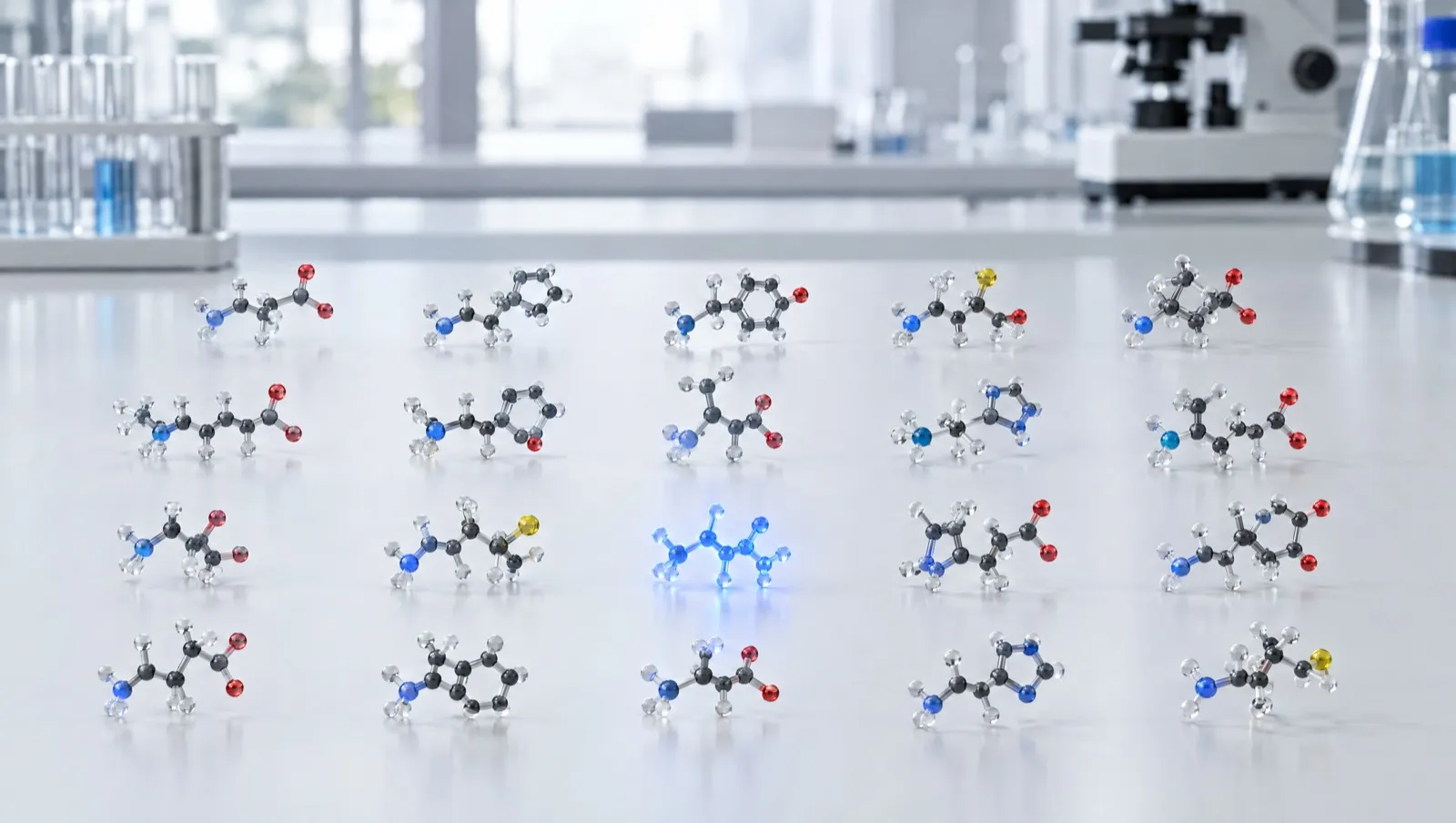
A peptide sequence is a list of the amino acids in a chain, in order. Each amino acid has a short code. Glycine, for example, is “Gly” in the three-letter code and “G” in the one-letter code [1].
The list always starts at one end of the chain, called the N-terminus (the end with a free amino group). It finishes at the other end, the C-terminus (the end with a free acid group) [1]. Reading it backwards describes a different molecule.
Extra marks show changes. “-NH₂” at the end means the acid end has been turned into an amide. “Ac-” at the start means an acetyl group has been added. A “D” before a residue means it is the mirror-image form [1]. Oxytocin, for example, is written Cys-Tyr-Ile-Gln-Asn-Cys-Pro-Leu-Gly-NH₂, with a note that the two cysteines are joined [2].
Small marks matter. Two sequences that differ by one symbol describe two different substances.
The short version
- Sequences run from N-terminus to C-terminus [1].
- Each residue has a three-letter and a one-letter code [1].
- Ac-, -NH₂, D- and cyclo mark modifications [1].
The basic rules
The IUPAC-IUB Joint Commission on Biochemical Nomenclature sets the conventions most journals and databases follow [1].
| Rule | What it means |
|---|---|
| Direction | The N-terminal residue is written on the left, the C-terminal residue on the right [1] |
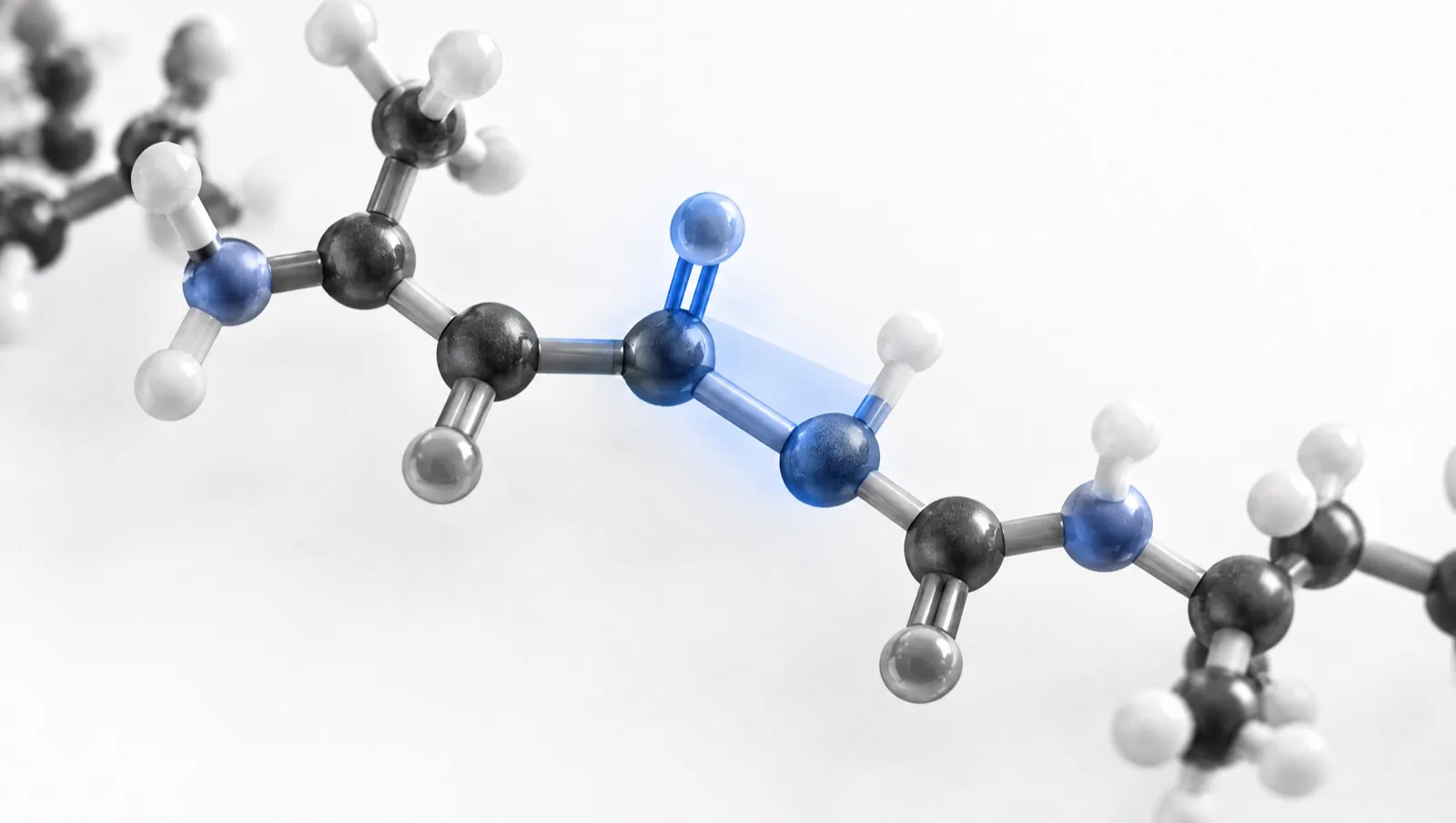
| Hyphens (three-letter system) | A hyphen between symbols represents the peptide bond, as in Gly-Gly [1] |
| Default chirality | Symbols denote the L form for chiral amino acids unless marked otherwise [1] |
| Numbering | Residues are numbered from the N-terminal end, starting at 1 [1] |
Three-letter and one-letter codes
The three-letter system (Ala, Arg, Asn…) is the one IUPAC-IUB recommends for ordinary text. The one-letter system was developed for long sequences, alignments and computing, where brevity matters. The guidance notes that one-letter codes are less easily understood by people unfamiliar with them [1].
| One-letter | Three-letter | Amino acid |
|---|---|---|
| A | Ala | Alanine |
| C | Cys | Cysteine |
| D | Asp | Aspartic acid |
| E | Glu | Glutamic acid |
| F | Phe | Phenylalanine |
| G | Gly | Glycine |
| H | His | Histidine |
| I | Ile | Isoleucine |
| K | Lys | Lysine |
| L | Leu | Leucine |
| M | Met | Methionine |
| N | Asn | Asparagine |
| P | Pro | Proline |
| Q | Gln | Glutamine |
| R | Arg | Arginine |
| S | Ser | Serine |
| T | Thr | Threonine |
| V | Val | Valine |
| W | Trp | Tryptophan |
| Y | Tyr | Tyrosine |
| U | Sec | Selenocysteine |
| B | Asx | Aspartic acid or asparagine (not distinguished) |
| Z | Glx | Glutamic acid or glutamine (not distinguished) |
| X | Xaa | Unknown or “other” amino acid |
All symbols above are from the IUPAC-IUB one-letter table [1]. For background on each residue, see Amino Acids: The 20 Building Blocks of Peptides.
Two cautions with one-letter codes
- Letters are not always initials. D is aspartic acid, E is glutamic acid, K is lysine and W is tryptophan [1]. Reading “D” as a D-amino acid, or “K” as potassium, is a common error.
- Check any non-standard marks. The 1983 rules mark D-residues with a “D” prefix [1]. If a document uses other conventions, such as lower-case letters, check its legend before interpreting them.
Reading the ends: N-terminus and C-terminus
A residue at the N-terminus has an amino group that is free, or at least not joined to another residue. It may carry another group instead, such as an acetyl or formyl group. The C-terminal residue has a free carboxyl group, or one converted into something else, such as an amide [1].
| Mark | Position | Meaning | Example |
|---|---|---|---|
| Ac- | N-terminus | N-terminal acetyl group [1] | Ac-Gly (acetylglycine) |
| Glp or pGlu | N-terminus | Pyroglutamyl (5-oxoproline) residue [1] | Glp-His-Pro-NH₂ (thyroliberin) [1] |
| -NH₂ | C-terminus | C-terminal amide | Thyroliberin, oxytocin [1, 2] |
| -OMe | C-terminus | Methyl ester [1] | Gly-OMe [1] |
Why do end groups matter? They change charge, mass and, often, biological activity. A review of 45 bioactive amidated peptides found that the C-terminal amide was required for the full biological activity of most amidated peptide hormones [3]. In solid-phase synthesis, the choice of resin decides whether the finished peptide has a C-terminal amide or a free acid [4]. A sequence that leaves out “-NH₂” may therefore describe a different compound from the one intended. See Peptide Modifications Explained.
D-residues and other stereochemistry
Residue symbols mean the L form unless marked otherwise. A D-residue is shown by writing D before the symbol, as in D-Ala or D-Phe [1]. A mixture of both forms at one position can be shown with the prefix ambo [1].
This matters in practice. Peptide chemists sometimes place D-amino acids at enzyme cleavage sites to slow breakdown [4]. Separately, D-isomers can form as impurities during synthesis, and they are hard to separate because D and L forms have identical physical and chemical properties apart from configuration [5]. A sequence written with D- prefixes is a specific design, not a mistake.
Rings, bridges and side-chain links
Disulfide bridges
Two cysteine residues can be joined through their sulfur atoms. Databases describe this in words or with a position note. PubChem lists oxytocin as “Cys-Tyr-Ile-Gln-Asn-Cys-Pro-Leu-Gly-NH2, cyclic 1-6 disulfide”, meaning residues 1 and 6 are joined [2]. In one-letter code, the same chain is CYIQNCPLG-NH₂ plus the disulfide note.
For multi-chain peptides, the note covers links between chains. UniProt lists human insulin with an A chain of 21 residues and a B chain of 30 residues, joined by two disulfide bonds between the chains and one within the A chain [6].
Head-to-tail cyclic peptides
When the ring is made entirely of ordinary backbone peptide bonds (a homodetic cyclic peptide), IUPAC-IUB writes the sequence in parentheses after “cyclo”. The example given is gramicidin S: cyclo(-Val-Orn-Leu-D-Phe-Pro-Val-Orn-Leu-D-Phe-Pro-) [1]. Orn is ornithine, a non-standard amino acid.
Rings closed by a disulfide, ester or side-chain amide link are called heterodetic cyclic peptides [1].
Side-chain (iso) peptide links
Glutathione is γ-glutamylcysteinylglycine. Its glutamic acid is linked through the side-chain (γ) carboxyl group rather than the backbone carboxyl [1, 7]. Writing it as a plain Glu-Cys-Gly would describe a different molecule.
Naming analogues: square brackets, des- and fragments
Many research peptides are variants of a named natural peptide. IUPAC-IUB has a compact system for this [1].
| Notation | Meaning | IUPAC-IUB example [1] |
|---|---|---|
| [Xaaq]name | Residue at position q replaced by Xaa | [Cit⁸]vasopressin; [Ile⁵,Ala⁷]angiotensin II |
| [D-Xaaq]name | Residue at position q replaced by its D form | [D-Ser¹]corticotropin |
| des-Xaaq-name | Residue at position q removed | des-Pro⁷-oxytocin |
| endo-Xaaqa-name | Extra residue inserted after position q | endo-Tyr⁴ᵃ-angiotensin II |
| name-(p–q)-peptide | Fragment containing residues p to q | α-melanotropin-(4-10)-peptide |
| N^ε-substituent | Group attached to a lysine side-chain amino group | N^ε2-Val-… |
The same logic appears in the research literature. For example, semaglutide is described as a GLP-1 analogue with two amino acid substitutions compared with human GLP-1 (Aib at position 8 and Arg at position 34), and a fatty-acid-containing group attached at lysine 26 [8]. Aib (α-aminoisobutyric acid) is a non-standard residue. Semaglutide is the active ingredient of approved medicines [4]; those products are regulated pharmaceuticals and are not equivalent to research material.
A worked example
Take oxytocin as listed in PubChem [2]:
Cys-Tyr-Ile-Gln-Asn-Cys-Pro-Leu-Gly-NH₂, cyclic 1-6 disulfide
Reading it step by step:
- Nine residues, so oxytocin is a nonapeptide [1, 2].
- No prefix at the left, so the N-terminal cysteine has a free amino group [1].
- “-NH₂” at the right, so the C-terminal glycine is an amide, not a free acid [1, 2].
- No D- prefixes, so every chiral residue is L [1].
- “Cyclic 1-6 disulfide”, so Cys1 and Cys6 are joined through their sulfur atoms, forming a ring [2].
- Cross-check the mass. PubChem gives the formula as C₄₃H₆₆N₁₂O₁₂S₂ and the molar mass as about 1007.2 g/mol [2]. A mass spectrum for genuine material should match this.
That last step links notation to quality control. See How to Read a Peptide COA and Reading a Peptide Mass Spectrum.
What this means in Australia
Names and identifiers carry legal weight. The Poisons Standard (October 2026) identifies substances by name, and in some cases by an extra identifier. It names CJC-1295 with its CAS number (863288-34-0), and names GHRP-2 as “pralmorelin (GHRP-2)”; both are in Schedule 4 and Appendix D, clause 5 [9]. Schedule 4 means prescription-only. Appendix D, clause 5 means possessing the substance without authority is illegal. Some peptides are captured only through class entries, and whether a class entry captures a specific compound is a legal question.
Peptide products are therapeutic goods. The TGA states that peptide products are regulated as therapeutic goods under the Therapeutic Goods Act 1989. It also warns that the labelling of unapproved peptide products may be inaccurate or misleading [10].
“Research use only” labels. The TGA has stated that a “research use only” disclaimer does not make supply lawful, and does not change a product’s regulatory status, permit importation, or remove advertising or supply obligations [10].
This is general information, not legal advice. Laws change; check the current Poisons Standard and TGA guidance.
Frequently asked questions
Which way is a peptide sequence read?
From the N-terminus on the left to the C-terminus on the right [1].
What does -NH₂ mean at the end of a peptide sequence?
It means the C-terminal carboxyl group is an amide rather than a free acid. Oxytocin is an example [1, 2].
What does Ac- mean at the start of a sequence?
It means the N-terminal amino group carries an acetyl group [1].
How are D-amino acids written?
With a D prefix before the residue symbol, such as D-Phe. Unmarked residues are L [1].
What does “cyclo” mean in a peptide name?
It means the sequence forms a ring closed by ordinary peptide bonds, written as cyclo(-…-) [1].
Why does K stand for lysine?
Most initials were already taken, so K was chosen as a remaining letter close to L in the alphabet [1].
References
- IUPAC-IUB Joint Commission on Biochemical Nomenclature (JCBN). Nomenclature and symbolism for amino acids and peptides. Recommendations 1983. Biochem J. 1984;219(2):345–373. doi:10.1042/bj2190345. PMID: 6743224. Web version: iupac.qmul.ac.uk/AminoAcid. Accessed 11 October 2026.
- National Center for Biotechnology Information. PubChem Compound Summary for CID 439302, Oxytocin. pubchem.ncbi.nlm.nih.gov/compound/439302. Accessed 11 October 2026.
- Merkler DJ. C-terminal amidated peptides: production by the in vitro enzymatic amidation of glycine-extended peptides and the importance of the amide to bioactivity. Enzyme Microb Technol. 1994;16(6):450–456. doi:10.1016/0141-0229(94)90014-0. PMID: 7764886
- Wang L, Wang N, Zhang W, et al. Therapeutic peptides: current applications and future directions. Signal Transduct Target Ther. 2022;7(1):48. doi:10.1038/s41392-022-00904-4. PMID: 35165272
- Badgujar D, Paritala ST, Matre S, Sharma N. Enantiomeric purity of synthetic therapeutic peptides: a review. Chirality. 2024;36(3):e23652. doi:10.1002/chir.23652. PMID: 38448043
- UniProt Consortium. UniProtKB entry P01308, Insulin (human). uniprot.org/uniprotkb/P01308/entry. Accessed 11 October 2026.
- National Center for Biotechnology Information. PubChem Compound Summary for CID 124886, Glutathione. pubchem.ncbi.nlm.nih.gov/compound/124886. Accessed 11 October 2026.
- Lau J, Bloch P, Schäffer L, et al. Discovery of the once-weekly glucagon-like peptide-1 (GLP-1) analogue semaglutide. J Med Chem. 2015;58(18):7370–7380. doi:10.1021/acs.jmedchem.5b00726. PMID: 26308095
- Therapeutic Goods (Poisons Standard—October 2026) Instrument 2026 (F2026L01327). Federal Register of Legislation. legislation.gov.au/F2026L01327/latest/text. Accessed 11 October 2026.
- Therapeutic Goods Administration. Understanding your responsibilities when importing, compounding and supplying unapproved peptide products. Safety advisory, 13 April 2026. tga.gov.au. Accessed 11 October 2026.
Important information and disclaimer
General information only. This article is published for general educational and informational purposes. It summarises published scientific literature and public regulatory information as at the “last reviewed” date shown above. It is not medical, health, pharmaceutical, veterinary or legal advice, and it must not be relied on as a substitute for advice from a qualified professional about your circumstances.
Not for human or animal use. Nothing in this article recommends, endorses or describes the use of any substance in humans or animals. Findings from cell, animal or early human studies cannot be assumed to apply to people. The compounds discussed have not been evaluated by the Therapeutic Goods Administration (TGA) for safety, quality or efficacy unless the article expressly states otherwise. Any research materials offered by Iconic Peptides are supplied solely for in vitro and laboratory research.
No therapeutic claims. Iconic Peptides makes no claim that any product treats, cures, prevents, alleviates or diagnoses any disease, condition or symptom. References to published studies, clinical trials or medicines approved by regulators are factual descriptions of the scientific and regulatory record. They are not representations about any product we supply.
Regulatory status. Many peptides are scheduled substances under the Poisons Standard. Some are prescription-only (Schedule 4), and some may not be possessed without authority (Appendix D). The TGA has stated that a “research use only” label does not make supply lawful, change a product’s regulatory status, or remove advertising or supply obligations. State and territory laws may also apply. You are responsible for knowing and complying with all laws that apply to you. Regulatory information in this article may change after the review date.
Accuracy and third-party sources. We take care to cite and verify every source, but we do not warrant that this article is complete, current or error-free. Citing a study or organisation does not mean that its authors or that organisation endorse Iconic Peptides.
Limitation of liability. To the maximum extent permitted by law, Iconic Peptides, its owners, employees and contributors exclude all liability for any loss, damage, injury or expense, whether direct, indirect or consequential, arising from use of or reliance on this article or any misuse of any product. Nothing in this disclaimer excludes, restricts or modifies any right or remedy under the Australian Consumer Law that cannot lawfully be excluded.
Age restriction. This website is intended for adults aged 18 and over.