In plain English
Many peptides are not stable in water for long. To keep them, manufacturers usually turn the solution into a dry powder by freeze-drying, also called lyophilisation [1, 2].
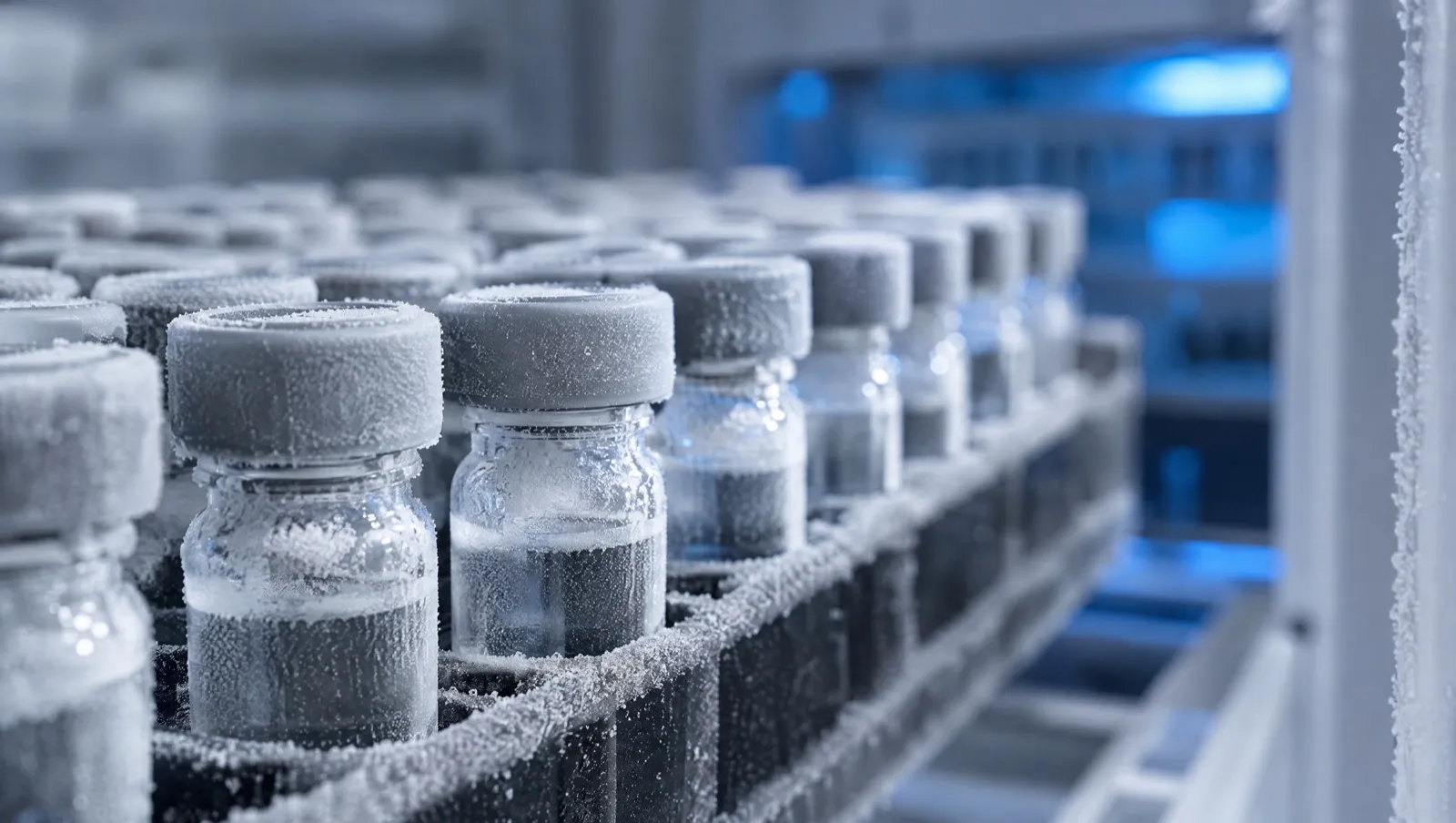
It works in three steps. First, the solution is frozen solid. Second, the air pressure is lowered and gentle heat is added, so the ice turns straight into vapour (sublimation, a change from solid to gas without melting). Third, a little more heat removes water that is still stuck to the solid [1, 3].
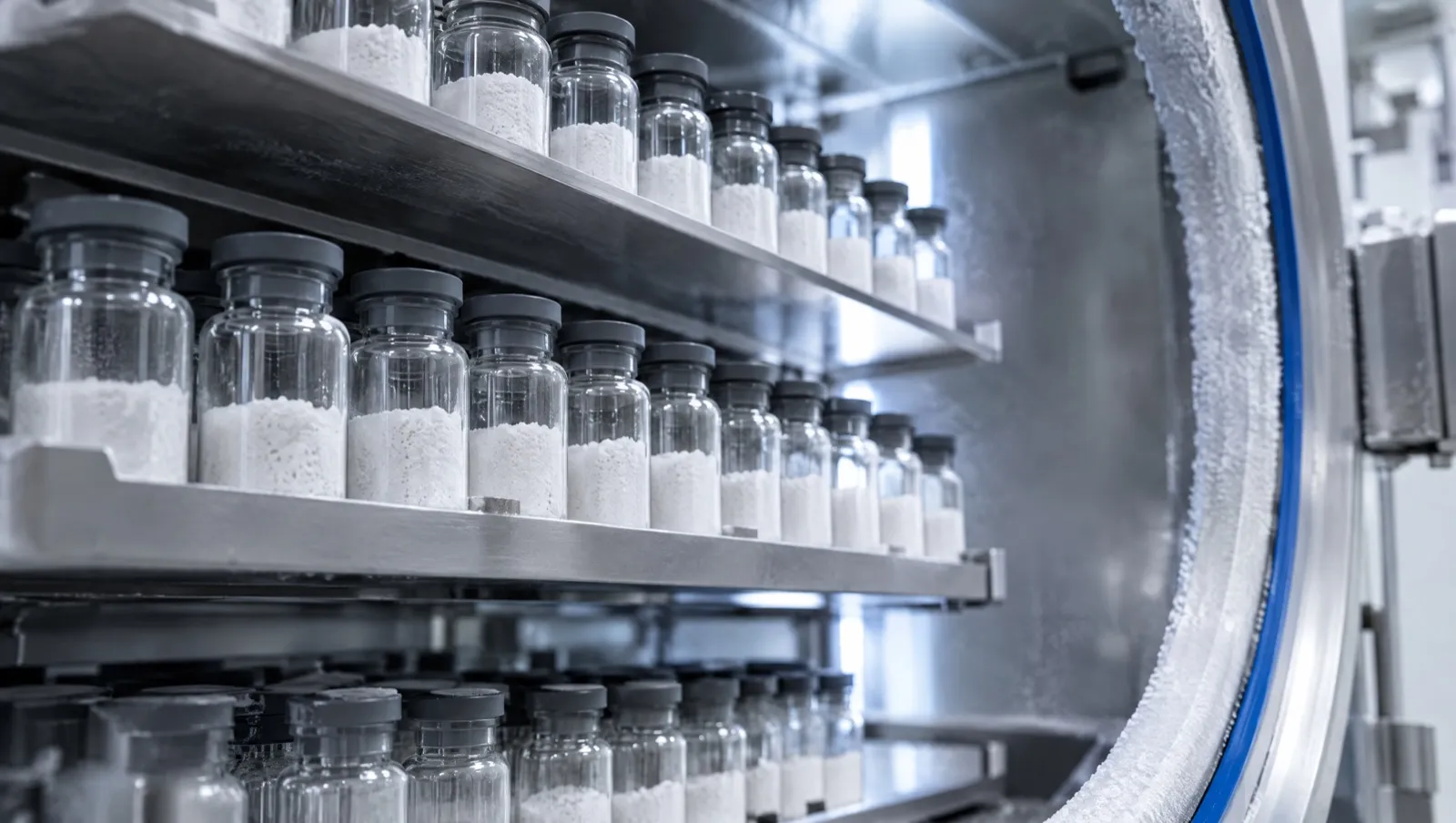
What is left is a light, white “cake” in the bottom of the vial. It is not perfectly dry. A small amount of water stays behind, and the amount matters for how long the peptide stays stable [6].
Freeze-drying is not gentle on every molecule. Freezing and drying both put stress on peptides and proteins, so the process has to be designed carefully [2, 4].
The short version
- Freeze, then remove the ice under vacuum, then remove bound water.
- Too much heat during drying can make the cake collapse.
- Some water always remains.
- The cake contains peptide plus water, counter-ions and any additives.
Why peptides are lyophilised
Peptides and proteins can degrade in solution through hydrolysis, deamidation, oxidation and aggregation. Removing water slows most of these reactions, so the solid state is preferred for many molecules with marginal stability in solution [2, 7]. The US FDA’s inspection guide lists the main advantages of lyophilisation as enhanced stability of a dry powder, removal of water without excessive heating, and rapid dissolution on reconstitution. It lists the disadvantages as longer handling and processing time, and the cost and complexity of the equipment [1].
The three stages
| Stage | What happens | Typical control points |
|---|---|---|
| 1. Freezing | The solution is cooled until water forms ice crystals; the solutes are concentrated into the spaces between crystals | Cooling rate, ice nucleation temperature, optional annealing [3, 4] |
| 2. Primary drying (sublimation) | Chamber pressure is lowered and shelves are warmed slightly; ice sublimes and the vapour is captured on a cold condenser | Product temperature kept below the collapse temperature; chamber pressure; shelf temperature [3] |
| 3. Secondary drying (desorption) | Shelf temperature is raised further to drive off water bound to the solid | Final temperature and time, which set residual moisture [3, 6] |
The FDA describes these as “three separate, unique, and interdependent processes” [1].
Freezing sets the structure
The freezing step determines the size and shape of the ice crystals, and therefore the pore structure left behind once the ice is gone. Larger pores let vapour escape faster in primary drying. Freezing also affects residual moisture, reconstitution time and peptide stability [4]. Faster cooling generally produces smaller ice crystals, while a controlled hold just below freezing (annealing) can grow larger, more uniform crystals.
Primary drying and the collapse temperature
Primary drying is usually the longest stage. As ice sublimes from the top down, a dried layer forms above the remaining frozen layer. If the product at the drying front gets too warm, the freeze-concentrated solid softens and flows, and the cake collapses: pores close, the cake shrinks, and drying slows.
Two temperatures define the upper limit for primary drying:
- Tg′: the glass transition temperature of the maximally freeze-concentrated solution.
- Collapse temperature (Tc): the temperature at which structure is visibly lost, usually a few degrees above Tg′.
A rational process sets a target product temperature just below the collapse temperature, then chooses shelf temperature and chamber pressure to hold it there without overloading the equipment [3].
Secondary drying and residual moisture
After the ice has gone, the solid still holds bound water, often several per cent by weight. Secondary drying lowers this to the target level. Residual moisture matters because water acts as a plasticiser: it lowers the glass transition temperature of the solid and increases molecular mobility. Moisture above roughly a monolayer of hydration generally speeds degradation [6]. Water content is commonly measured by Karl Fischer titration and may be reported on a Certificate of Analysis.
Excipients: what else can be in the cake
Pharmaceutical protein products are often freeze-dried with excipients:
- Lyoprotectants (such as sucrose or trehalose) form a glassy matrix that protects structure during drying and storage [2, 5].
- Bulking agents (such as mannitol or glycine) give a firm, elegant cake when the active ingredient is present in very small amounts [5].
- Buffers control pH, although some buffer salts shift pH sharply as they crystallise during freezing [2].
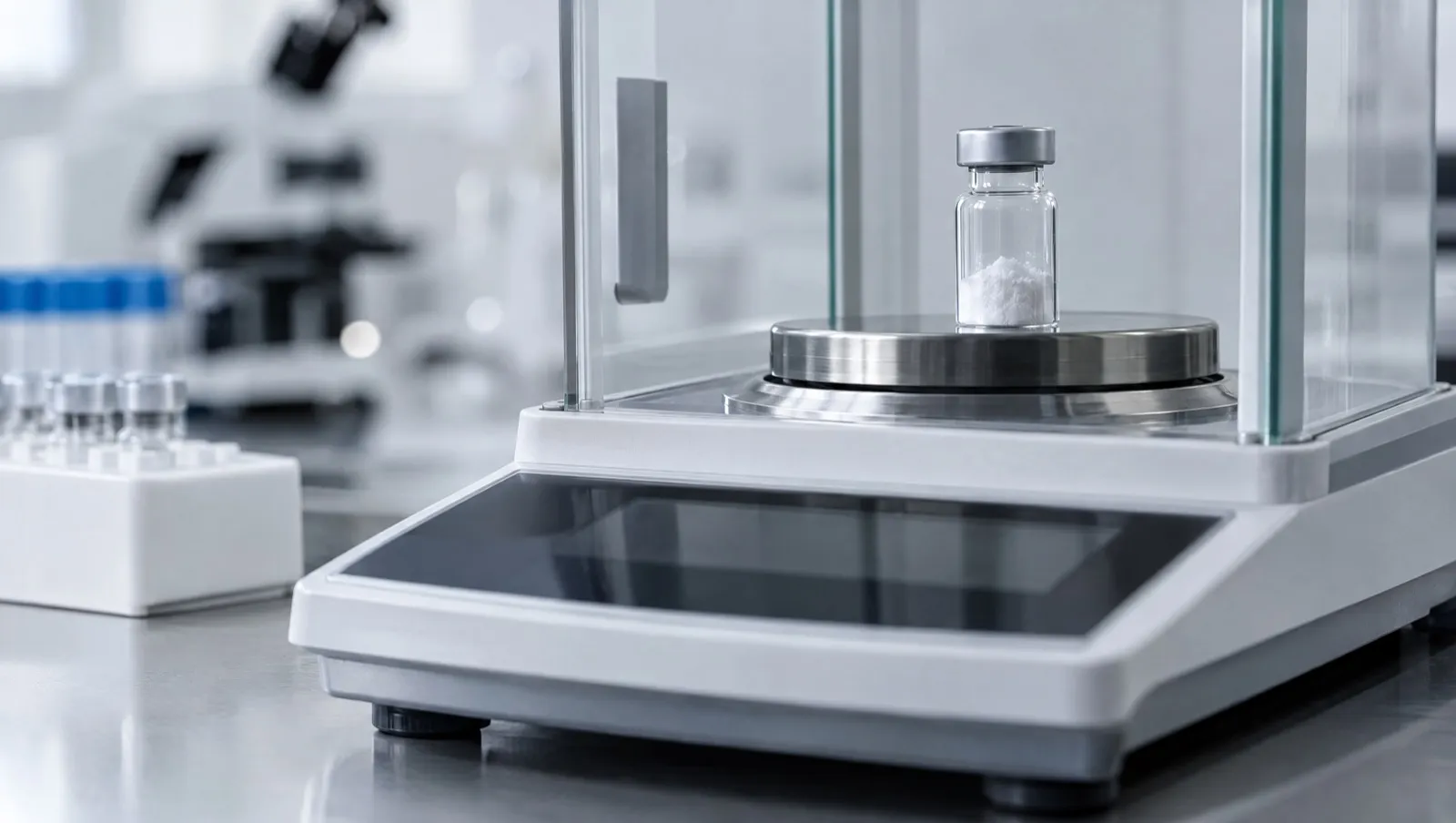
Research-grade synthetic peptides are frequently lyophilised from water or dilute acid without added excipients. The cake then consists of the peptide, its counter-ion (often trifluoroacetate or acetate) and residual water. This is why gross powder mass and net peptide content differ [8]. See Purity vs Peptide Content and Peptide Counter-Ions.
Reading a lyophilised cake
Cake appearance is a quick, non-destructive check, but it is not a test of purity or identity.
| Observation | Possible meaning |
|---|---|
| Uniform, white, intact cake | Consistent with a controlled process |
| Cake shrunk away from the vial wall | Some shrinkage is common and not necessarily a quality problem |
| Collapsed, glassy or sticky material | Product exceeded its collapse temperature during drying, or absorbed moisture later [3] |
| Powder scattered over walls and stopper | Movement in transit; usually harmless, and collected by a brief tap or centrifugation before opening |
| Very small amount of material | Normal for low-milligram fills; the cake can be barely visible |
| Yellowing or discolouration | Possible degradation or contamination; check the COA and storage history |
Because the cake is porous and often hygroscopic (water-attracting), a cold vial should reach room temperature before opening, so moisture does not condense on the powder. See Peptide Storage and Stability.
Stresses during freeze-drying
Freeze-drying protects peptides over time, but the process itself creates stresses [2, 4, 7]:
- Cold and freeze-concentration. As ice forms, solutes, salts and the peptide become highly concentrated in the remaining liquid, and pH can shift.
- Ice–liquid interfaces. Molecules can unfold or aggregate at the large surface area of ice crystals.
- Dehydration. Removing the water shell around a molecule can disturb its structure.
Most of this research concerns proteins. For peptides, a review of physical stability lists lyophilisation, temperature and surfaces among the external factors that influence aggregation [9].
Lyophilisation in reference standards
High-value peptide reference standards are themselves lyophilised. Pharmacopoeial work on peptide reference standards describes vialing, lyophilisation, analytical testing and stability studies, and a mass-balance approach that accounts for water and counter-ion content when assigning a value to the vialed material [8]. This shows why accurate water content and peptide content both matter after freeze-drying.
What this means in Australia
- Manufacturing therapeutic goods requires a licence. Under the Therapeutic Goods Act 1989, manufacturers of therapeutic goods for human use must, with certain exceptions, hold a licence or a conformity assessment certificate; overseas manufacturers can instead obtain good manufacturing practice (GMP) certification after a TGA inspection [10]. The TGA has said that “manufacture” includes applying a label to a blank vial [11].
- Not on the ARTG. Unapproved peptide products are not entered on the Australian Register of Therapeutic Goods and have not been assessed by the TGA for safety, quality or effectiveness [12].
- Scheduling. Several peptides are named in the current Poisons Standard (October 2026), some as Schedule 4 (prescription-only) and Appendix D, clause 5 (possession without authority is illegal) [13]. Being lyophilised does not change a substance’s schedule.
- Labels don’t change status. The TGA has stated that a “research use only” disclaimer does not make supply lawful, change regulatory status, permit importation, or remove advertising or supply obligations [12].
This is general information, not legal advice. Laws change; check the current Poisons Standard and TGA guidance.
Frequently asked questions
What does lyophilised mean?
Lyophilised means freeze-dried: the material was frozen and the ice removed under vacuum by sublimation, leaving a dry solid [1].
What are the stages of lyophilisation?
There are three: freezing, primary drying (sublimation of ice) and secondary drying (desorption of bound water) [1, 3].
Why does a lyophilised cake collapse?
Collapse happens when the product gets warmer than its collapse temperature during primary drying, so the freeze-concentrated solid softens and loses its pore structure. It can also follow moisture uptake after drying [3, 6].
Is a lyophilised peptide completely dry?
No. Some residual water always remains after secondary drying, and its level affects stability in the solid state [6].
Why does a vial weigh more than its peptide content?
The powder also contains counter-ions, residual water and any excipients. Net peptide content accounts for these [8].
References
- US Food and Drug Administration. Lyophilization of Parenteral (7/93). Inspection guide. fda.gov. Accessed 11 October 2026.
- Wang W. Lyophilization and development of solid protein pharmaceuticals. Int J Pharm. 2000;203(1–2):1–60. doi:10.1016/s0378-5173(00)00423-3. PMID: 10967427
- Tang X, Pikal MJ. Design of freeze-drying processes for pharmaceuticals: practical advice. Pharm Res. 2004;21(2):191–200. doi:10.1023/b:pham.0000016234.73023.75. PMID: 15032301
- Kasper JC, Friess W. The freezing step in lyophilization: physico-chemical fundamentals, freezing methods and consequences on process performance and quality attributes of biopharmaceuticals. Eur J Pharm Biopharm. 2011;78(2):248–263. doi:10.1016/j.ejpb.2011.03.010. PMID: 21426937
- Carpenter JF, Pikal MJ, Chang BS, Randolph TW. Rational design of stable lyophilized protein formulations: some practical advice. Pharm Res. 1997;14(8):969–975. doi:10.1023/a:1012180707283. PMID: 9279875
- Towns JK. Moisture content in proteins: its effects and measurement. J Chromatogr A. 1995;705(1):115–127. doi:10.1016/0021-9673(94)01257-f. PMID: 7620565
- Chang LL, Pikal MJ. Mechanisms of protein stabilization in the solid state. J Pharm Sci. 2009;98(9):2886–2908. doi:10.1002/jps.21825. PMID: 19569054
- McCarthy D, Han Y, Carrick K, et al. Reference standards to support quality of synthetic peptide therapeutics. Pharm Res. 2023;40(6):1317–1328. doi:10.1007/s11095-023-03493-1. PMID: 36949371
- Zapadka KL, Becher FJ, Gomes Dos Santos AL, Jackson SE. Factors affecting the physical stability (aggregation) of peptide therapeutics. Interface Focus. 2017;7(6):20170030. doi:10.1098/rsfs.2017.0030. PMID: 29147559
- Therapeutic Goods Administration. Manufacturing. tga.gov.au. Accessed 11 October 2026.
- Therapeutic Goods Administration. Unapproved peptide product promoters and suppliers are put on notice. Media release, 20 July 2026. tga.gov.au. Accessed 11 October 2026.
- Therapeutic Goods Administration. Understanding your responsibilities when importing, compounding and supplying unapproved peptide products. Safety advisory, 13 April 2026. tga.gov.au. Accessed 11 October 2026.
- Therapeutic Goods (Poisons Standard—October 2026) Instrument 2026 (F2026L01327). Federal Register of Legislation. legislation.gov.au. Accessed 11 October 2026.
Important information and disclaimer
General information only. This article is published for general educational and informational purposes. It summarises published scientific literature and public regulatory information as at the “last reviewed” date shown above. It is not medical, health, pharmaceutical, veterinary or legal advice, and it must not be relied on as a substitute for advice from a qualified professional about your circumstances.
Not for human or animal use. Nothing in this article recommends, endorses or describes the use of any substance in humans or animals. Findings from cell, animal or early human studies cannot be assumed to apply to people. The compounds discussed have not been evaluated by the Therapeutic Goods Administration (TGA) for safety, quality or efficacy unless the article expressly states otherwise. Any research materials offered by Iconic Peptides are supplied solely for in vitro and laboratory research.
No therapeutic claims. Iconic Peptides makes no claim that any product treats, cures, prevents, alleviates or diagnoses any disease, condition or symptom. References to published studies, clinical trials or medicines approved by regulators are factual descriptions of the scientific and regulatory record. They are not representations about any product we supply.
Regulatory status. Many peptides are scheduled substances under the Poisons Standard. Some are prescription-only (Schedule 4), and some may not be possessed without authority (Appendix D). The TGA has stated that a “research use only” label does not make supply lawful, change a product’s regulatory status, or remove advertising or supply obligations. State and territory laws may also apply. You are responsible for knowing and complying with all laws that apply to you. Regulatory information in this article may change after the review date.
Accuracy and third-party sources. We take care to cite and verify every source, but we do not warrant that this article is complete, current or error-free. Citing a study or organisation does not mean that its authors or that organisation endorse Iconic Peptides.
Limitation of liability. To the maximum extent permitted by law, Iconic Peptides, its owners, employees and contributors exclude all liability for any loss, damage, injury or expense, whether direct, indirect or consequential, arising from use of or reliance on this article or any misuse of any product. Nothing in this disclaimer excludes, restricts or modifies any right or remedy under the Australian Consumer Law that cannot lawfully be excluded.
Age restriction. This website is intended for adults aged 18 and over.