In plain English
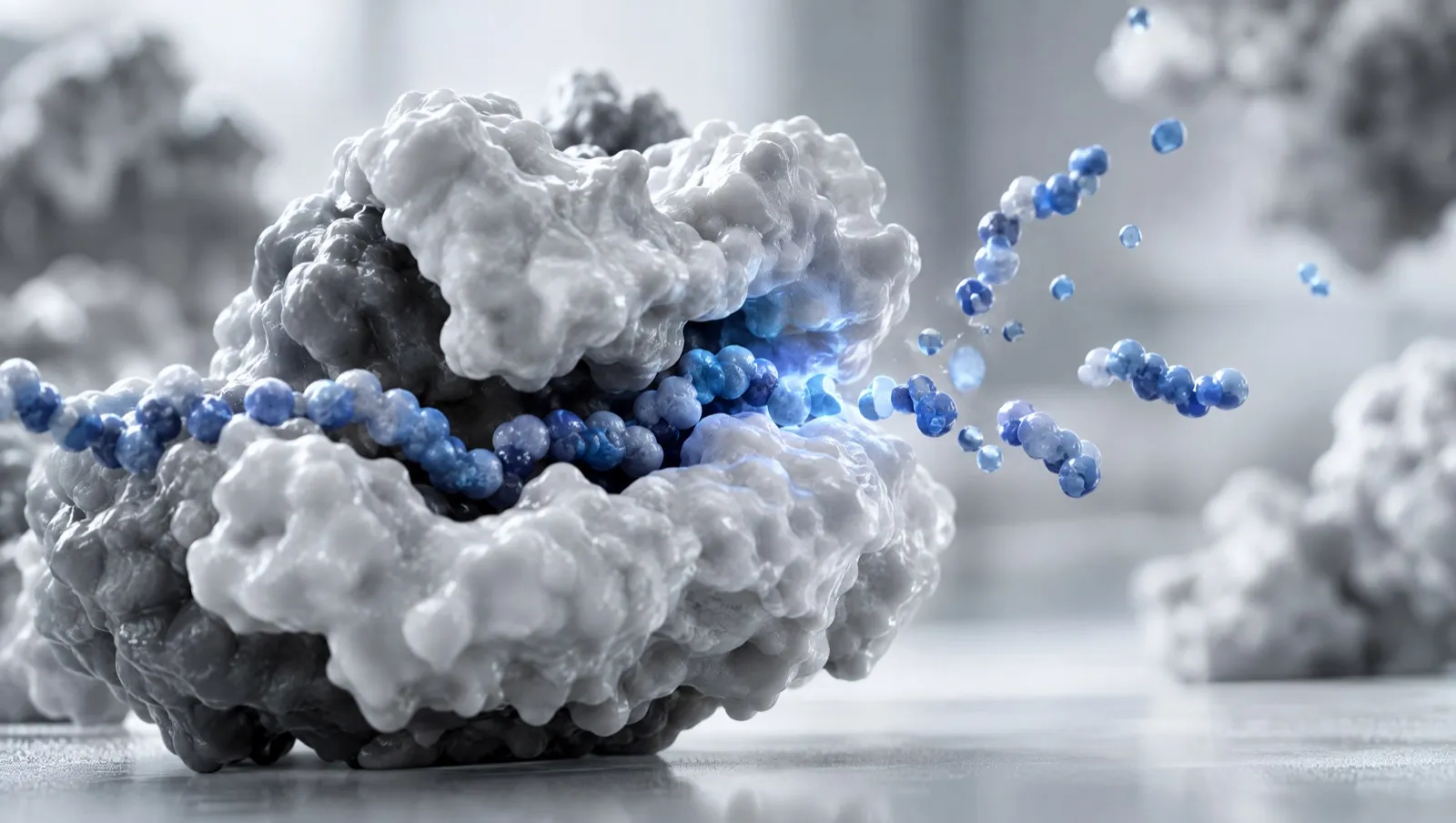
A peptide is a short chain of amino acids (the building blocks of proteins). The links in the chain are called peptide bonds. Living things are full of proteases (enzymes that cut those bonds). Proteases are found in blood, the liver, the kidneys and almost everywhere else [1, 2].
So most natural peptides do not last long once they are in blood or tissue. The kidneys also filter small peptides out quickly [2]. Half-life (the time for half of the peptide to disappear) is often only minutes. For example, somatostatin, a natural 14-amino-acid hormone, lasts only a few minutes in blood plasma [1].
Much of this knowledge comes from test-tube experiments with plasma or serum, plus animal studies. Measurements can change with the test conditions, so a half-life measured in one setting may not match another [5].
The short version
- Proteases and kidney filtering are the two main reasons peptides disappear quickly [1, 2].
- Half-life depends on the test system as well as the molecule [5].
- Chemical changes to a peptide can lengthen its half-life [1, 3].
Key facts
| Property | Detail |
|---|---|
| What half-life means | The time for the concentration of a substance to fall by half |
| Main causes of short peptide half-life | Proteolytic degradation and fast renal clearance [1, 2] |
| Where proteases act | Throughout the body, not only in classic elimination organs such as the liver and kidneys [2] |
| Example | GLP-1 is cut by dipeptidyl peptidase-IV in human plasma in vitro, with a half-life of about 20 minutes at 37 °C [4] |
| Example | Somatostatin lasts a few minutes in plasma; its shortened D-amino-acid analogue octreotide about 1.5 hours [1] |
| Common half-life strategies | D-amino acids, N- and C-terminal modification, disulfide bonds, PEGylation, albumin binding [1, 2, 3] |
What are proteases?
Proteases (also called peptidases or proteolytic enzymes) are enzymes that cut peptide bonds by hydrolysis. The full set of proteases an organism produces is called its degradome. Genome comparisons have mapped the degradomes of humans and mice, and they show proteolysis is central to how cells control behaviour, survival and death [8].
Proteases differ in where they cut. Some trim amino acids from the end of a chain; the GLP-1 example below involves an enzyme that removes two residues from the N-terminus [4]. Others cut at internal sites. Reviews of peptide stability list the main proteases of human blood, liver and kidney, with their cleavage preferences and known inhibitors, so that likely cut sites in a new peptide can be predicted [1].
Because proteases and peptidases are found throughout the body, peptide breakdown is not limited to classic elimination organs such as the liver and kidneys [2].
Why do peptides have short half-lives?
Reviews describe the same two main routes for natural peptides [1, 2, 3]:
- Enzymatic degradation. Unmodified peptides usually undergo extensive cleavage by proteases, giving short plasma half-lives [2].
- Renal clearance. Peptides are generally small enough to be freely filtered by the kidneys. Filtration, followed by proteolysis in the kidney, contributes to the elimination of many peptides [2].
Peptides also tend to have low permeability across membranes, and natural peptides often show rapid clearance and short half-lives overall. Pharmacologists summarise these traits as poor ADME properties (absorption, distribution, metabolism and excretion) [3].
A worked example: GLP-1 and DPP-IV
GLP-1 is a natural peptide hormone that is known to be cleared rapidly from the circulation. In a 1995 study, researchers added the active form, GLP-1 (7–36) amide, to human plasma in the laboratory [4]:
- The plasma removed two amino acids from the N-terminus, producing GLP-1 (9–36) amide. The half-life of this reaction was 20.4 ± 1.4 minutes at 37 °C.
- Inhibitors of the enzyme dipeptidyl peptidase-IV (DPP-IV), or cooling to 4 °C, completely prevented the cut. EDTA and aprotinin did not.
- The truncated form was also found in human blood samples, which suggested DPP-IV may inactivate GLP-1 in vivo as well.
The example shows two general points. A single, specific enzyme can control a peptide’s lifetime. And just one cut, removing two residues, can change what is left behind [4].
A worked example: somatostatin and octreotide
Somatostatin is a natural cyclic peptide hormone of 14 amino acids (PubChem lists its molecular formula as C₇₆H₁₀₄N₁₈O₁₉S₂) [11]. Its plasma half-life is only a few minutes [1].
Octreotide is a shorter synthetic analogue (C₄₉H₆₆N₁₀O₁₀S₂, molar mass about 1019.2 g/mol) [10]. It was designed by reducing the number of amino acids and replacing natural L-amino acids with D-amino acids. Its plasma half-life is about 1.5 hours [1]. This is one of the classic illustrations of how sequence design can extend half-life.
How is peptide stability measured?
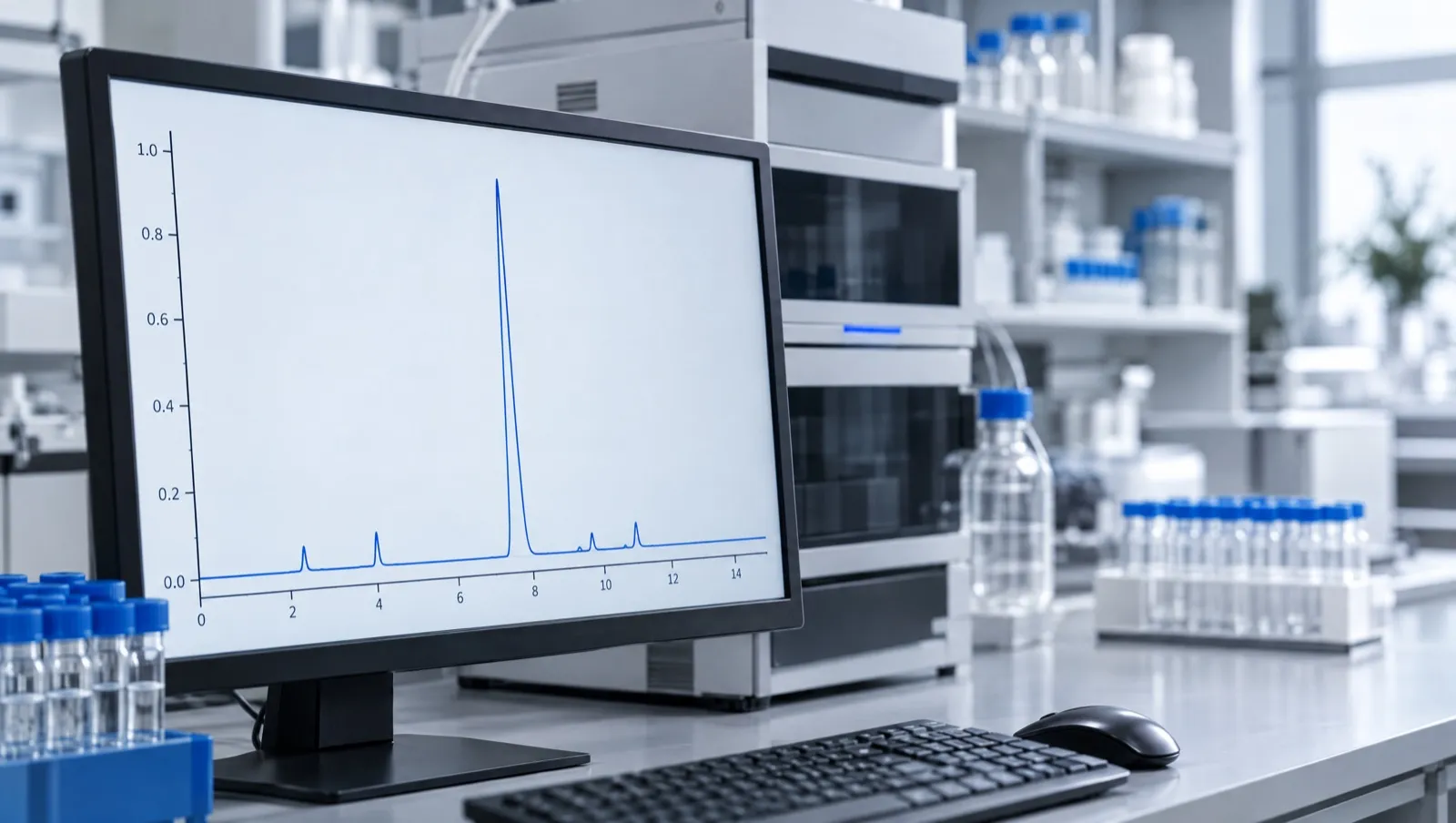
Stability is usually tested by adding a peptide to a biological fluid, sampling over time, and measuring how much intact peptide remains, for example with HPLC or mass spectrometry [4, 5]. The choice of fluid matters [5]:
- Serum is the liquid left after blood has clotted. Clotting activates some proteases.
- Plasma is collected with anticoagulants, which can inhibit some proteases. EDTA blocks metal- and calcium-dependent proteases; heparin blocks enzymes such as thrombin.
In a mouse study comparing these matrices, peptides from three families were generally broken down faster in serum than in plasma, and all were more stable in fresh whole blood. The order of degradation rates between peptides also changed between conditions. The authors concluded that serum or plasma tests can point chemists towards cut sites that matter less in vivo [5].
Temperature also matters. In the GLP-1 study above, cooling plasma to 4 °C stopped degradation entirely [4]. Reported half-lives should always be read alongside the test system, species and temperature.
How do chemists extend peptide half-life?
Reviews describe a set of established strategies [1, 2, 3]:
| Strategy | How it works |
|---|---|
| D-amino acid substitution | Replaces natural L-amino acids with their mirror-image D-forms, as in octreotide [1] |
| N- and C-terminal modification | Chemically capping the ends of the chain, for example by acetylation or amidation [1, 2] |
| Other amino acid substitutions | Swaps residues at known cut sites [2] |
| Disulfide bonds and cyclisation | Adds internal cross-links that constrain the chain [2] |
| PEGylation | Attaches polyethylene glycol chains. A PEG conjugate of interferon alfa-2b had a 330-fold longer plasma half-life than the native protein [1] |
| Albumin binding | Attaches a fatty acid so the peptide binds reversibly to serum albumin [6, 7] |
| Conjugation to larger proteins | Links the peptide to an antibody fragment or albumin [2] |
The GLP-1 analogues liraglutide and semaglutide are well-documented examples of albumin binding. In semaglutide, the developers substituted an unnatural amino acid (Aib) at position 8, within the two N-terminal residues that DPP-IV removes from GLP-1, and attached a fatty acid chain via a linker to increase albumin affinity [4, 6]. The stated aim was full stability against metabolic degradation [6]. In mini-pigs, the plasma half-life of semaglutide was 46.1 hours [6]. Optimising the fatty acid and linker allowed albumin binding to be maximised while keeping activity at the GLP-1 receptor [7].
Each of these changes creates a different molecule. A modified analogue has its own structure, its own stability profile and its own evidence base. See How Peptide Signalling Works for why receptor activity also has to be re-checked after modification.
Breakdown in the vial versus breakdown in biology
Proteolysis is an enzymatic process in biological fluids. Peptides can also degrade chemically, without enzymes, during manufacture and storage. Reported degradation routes include oxidation of side chains, β-elimination, diketopiperazine formation, pyroglutamate formation and succinimide formation [9]. These degradation products can affect early functional studies and lead to wrong conclusions [9].
Good laboratory handling limits chemical degradation. See Lyophilised Peptides: Storage, Stability and Degradation and Common Peptide Impurities.
What this means in Australia
A longer half-life does not make a medicine. Half-life engineering is a normal part of medicine development. Only products that the TGA has evaluated and included on the Australian Register of Therapeutic Goods (ARTG) are approved medicines. Peptide products that are not on the ARTG are unapproved therapeutic goods [12].
Each analogue is its own substance. Modifying a peptide creates a new molecule, and its regulatory status depends on that substance. The Poisons Standard (October 2026) names several peptides individually and also includes class entries, such as “growth hormone releasing hormones (GHRHs)”, which is in Schedule 4 and Appendix D, clause 5 [13]. Schedule 4 means prescription-only. Appendix D, clause 5 means possessing the substance without authority is illegal. Not being named does not mean a substance is unregulated [12, 13].
“Research use only” labels. In April 2026 the TGA stated that a “research use only” disclaimer does not make supply lawful, and does not change a product’s regulatory status, permit importation, or remove advertising or supply obligations [12]. See Are Peptides Legal in Australia?.
This is general information, not legal advice. Laws change; check the current Poisons Standard and TGA guidance.
Frequently asked questions
What is peptide half-life?
It is the time for the concentration of a peptide in a biological fluid to fall by half. For many natural peptides it is only minutes, because of proteolysis and renal clearance [1, 2].
Why do peptides break down so quickly?
Proteases throughout the body cut peptide bonds, and small peptides are freely filtered by the kidneys [2].
What enzyme breaks down GLP-1?
In human plasma in vitro, dipeptidyl peptidase-IV (DPP-IV) removes two N-terminal amino acids from GLP-1 (7–36) amide, with a half-life of about 20 minutes at 37 °C [4].
Is half-life the same in serum, plasma and blood?
No. In a mouse study, peptides were generally degraded faster in serum than in plasma, and were more stable in fresh blood than in either [5].
How can peptide half-life be extended?
Common strategies include D-amino acid substitution, terminal capping, cyclisation, PEGylation and fatty-acid modifications that bind albumin [1, 2, 6].
References
- Werle M, Bernkop-Schnürch A. Strategies to improve plasma half life time of peptide and protein drugs. Amino Acids. 2006;30(4):351–367. doi:10.1007/s00726-005-0289-3. PMID: 16622600
- Diao L, Meibohm B. Pharmacokinetics and pharmacokinetic-pharmacodynamic correlations of therapeutic peptides. Clin Pharmacokinet. 2013;52(10):855–868. doi:10.1007/s40262-013-0079-0. PMID: 23719681
- Di L. Strategic approaches to optimizing peptide ADME properties. AAPS J. 2015;17(1):134–143. doi:10.1208/s12248-014-9687-3. PMID: 25366889
- Deacon CF, Johnsen AH, Holst JJ. Degradation of glucagon-like peptide-1 by human plasma in vitro yields an N-terminally truncated peptide that is a major endogenous metabolite in vivo. J Clin Endocrinol Metab. 1995;80(3):952–957. doi:10.1210/jcem.80.3.7883856. PMID: 7883856
- Böttger R, Hoffmann R, Knappe D. Differential stability of therapeutic peptides with different proteolytic cleavage sites in blood, plasma and serum. PLoS One. 2017;12(6):e0178943. doi:10.1371/journal.pone.0178943. PMID: 28575099
- Lau J, Bloch P, Schäffer L, et al. Discovery of the Once-Weekly Glucagon-Like Peptide-1 (GLP-1) Analogue Semaglutide. J Med Chem. 2015;58(18):7370–7380. doi:10.1021/acs.jmedchem.5b00726. PMID: 26308095
- Knudsen LB, Lau J. The Discovery and Development of Liraglutide and Semaglutide. Front Endocrinol (Lausanne). 2019;10:155. doi:10.3389/fendo.2019.00155. PMID: 31031702
- Puente XS, Sánchez LM, Overall CM, López-Otín C. Human and mouse proteases: a comparative genomic approach. Nat Rev Genet. 2003;4(7):544–558. doi:10.1038/nrg1111. PMID: 12838346
- D’Hondt M, Bracke N, Taevernier L, et al. Related impurities in peptide medicines. J Pharm Biomed Anal. 2014;101:2–30. doi:10.1016/j.jpba.2014.06.012. PMID: 25044089
- National Center for Biotechnology Information. PubChem Compound Summary for CID 448601, Octreotide. pubchem.ncbi.nlm.nih.gov/compound/448601. Accessed 11 October 2026.
- National Center for Biotechnology Information. PubChem Compound Summary for CID 16129706, Somatostatin. pubchem.ncbi.nlm.nih.gov/compound/16129706. Accessed 11 October 2026.
- Therapeutic Goods Administration. Understanding your responsibilities when importing, compounding and supplying unapproved peptide products. Safety advisory, 13 April 2026. tga.gov.au. Accessed 11 October 2026.
- Therapeutic Goods (Poisons Standard—October 2026) Instrument 2026 (F2026L01327). Federal Register of Legislation. legislation.gov.au/F2026L01327/latest/text. Accessed 11 October 2026.
Important information and disclaimer
General information only. This article is published for general educational and informational purposes. It summarises published scientific literature and public regulatory information as at the “last reviewed” date shown above. It is not medical, health, pharmaceutical, veterinary or legal advice, and it must not be relied on as a substitute for advice from a qualified professional about your circumstances.
Not for human or animal use. Nothing in this article recommends, endorses or describes the use of any substance in humans or animals. Findings from cell, animal or early human studies cannot be assumed to apply to people. The compounds discussed have not been evaluated by the Therapeutic Goods Administration (TGA) for safety, quality or efficacy unless the article expressly states otherwise. Any research materials offered by Iconic Peptides are supplied solely for in vitro and laboratory research.
No therapeutic claims. Iconic Peptides makes no claim that any product treats, cures, prevents, alleviates or diagnoses any disease, condition or symptom. References to published studies, clinical trials or medicines approved by regulators are factual descriptions of the scientific and regulatory record. They are not representations about any product we supply.
Regulatory status. Many peptides are scheduled substances under the Poisons Standard. Some are prescription-only (Schedule 4), and some may not be possessed without authority (Appendix D). The TGA has stated that a “research use only” label does not make supply lawful, change a product’s regulatory status, or remove advertising or supply obligations. State and territory laws may also apply. You are responsible for knowing and complying with all laws that apply to you. Regulatory information in this article may change after the review date.
Accuracy and third-party sources. We take care to cite and verify every source, but we do not warrant that this article is complete, current or error-free. Citing a study or organisation does not mean that its authors or that organisation endorse Iconic Peptides.
Limitation of liability. To the maximum extent permitted by law, Iconic Peptides, its owners, employees and contributors exclude all liability for any loss, damage, injury or expense, whether direct, indirect or consequential, arising from use of or reliance on this article or any misuse of any product. Nothing in this disclaimer excludes, restricts or modifies any right or remedy under the Australian Consumer Law that cannot lawfully be excluded.
Age restriction. This website is intended for adults aged 18 and over.