In plain English
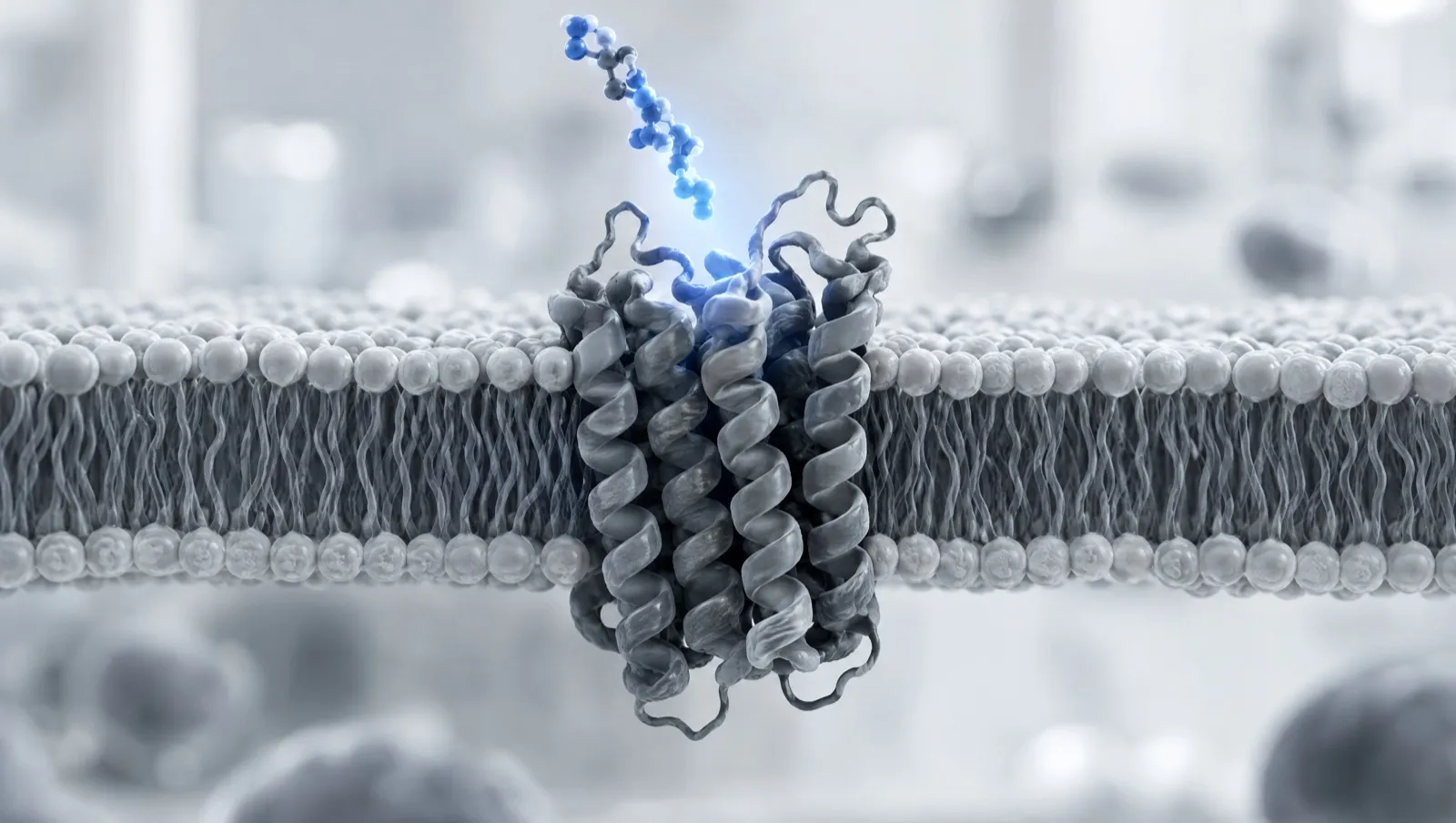
Cells are wrapped in a membrane (a thin, oily outer layer). Most peptides cannot pass through it easily [14]. So a peptide hormone does not usually enter the cell to deliver its message. Instead it docks onto a receptor (a protein that sits in the membrane and recognises one kind of molecule) [1].
When the right peptide binds, the receptor changes shape. That shape change starts a relay inside the cell. In the largest receptor family, the relay uses G proteins (switch-like proteins) and small molecules called second messengers, such as cyclic AMP (cAMP) [6, 7].
Scientists have worked this out mostly from experiments with cells, purified proteins and receptor structures [1, 4]. Knowing which receptor a peptide binds says how a signal starts. It does not say what a particular peptide does in a whole animal or a person. That needs separate studies.
The short version
- Most peptides signal through receptors on the cell surface [1].
- GPCRs are the largest family of these receptors [4].
- Second messengers carry the signal inside the cell [6, 7].
Key facts
| Property | Detail |
|---|---|
| Main receptor family for peptides | G protein-coupled receptors (GPCRs), the largest group of cell-surface receptors in humans [4] |
| GPCR structure | Seven membrane-spanning segments; activation involves a change in receptor shape [1, 11] |
| Typical second messengers | Cyclic AMP (cAMP); inositol trisphosphate (IP3) and calcium [7, 8] |
| How signals are switched off | G proteins convert GTP to GDP; β-arrestins block further G protein coupling [5, 6] |
| Other peptide receptor types | Receptor tyrosine kinases (for example, insulin and IGF receptors); cytokine-type receptors that use JAK2 (for example, the growth hormone receptor) [9, 10, 15] |
| Drug relevance | About 34% of FDA-approved drugs act at GPCRs; nearly 50 approved peptide drugs target GPCRs [2, 3] |
Why do peptides need receptors?
Peptides are generally polar and relatively large, and their permeability across cell membranes is low [14]. A cell therefore “reads” most peptide signals at its surface. The receptor does two jobs. It recognises a specific signal molecule, and it converts that binding event into a change inside the cell [6].
This two-step idea has a long history. In the 1950s and 1960s, Earl Sutherland showed that a hormone acting at the cell surface (the “first messenger”) is converted into a signal that acts inside the cell (the “second messenger”). He identified that second messenger as cyclic AMP and received the 1971 Nobel Prize in Physiology or Medicine [6, 7].
Selectivity comes from the receptor. A peptide affects only cells that carry a matching receptor, and the same peptide can produce different responses in different cell types, depending on what sits downstream of the receptor [1, 4].
What is a G protein-coupled receptor?
A G protein-coupled receptor (GPCR) is a membrane protein that crosses the membrane seven times. GPCRs respond to hormones, neurotransmitters, light, odours and many other stimuli [1, 11]. The Nobel committee that recognised Robert Lefkowitz and Brian Kobilka in 2012 noted that about a thousand genes code for receptors of this type [11].
GPCRs are a major drug target class. A 2017 analysis found that 475 drugs, about 34% of all drugs approved by the US FDA, act at 108 different GPCRs [2]. A 2020 review counted nearly 50 approved peptide drugs that act at GPCRs. Most of them are agonists (molecules that activate a receptor) created by modifying the sequence of a natural peptide ligand [3].
High-resolution structures, including images of a receptor caught in its active state, have shown how ligand binding changes receptor shape [1, 11]. For a broader introduction to peptides themselves, see What Are Peptides?.
How a GPCR passes on the signal: G proteins
G proteins are named for binding guanosine triphosphate (GTP). The classic G proteins are made of three subunits, called alpha, beta and gamma [6, 16].
The cycle runs like a switch [6]:
- Resting state. The alpha subunit holds GDP and the G protein is inactive.
- Activation. A ligand-bound receptor prompts the alpha subunit to swap GDP for GTP. The G protein is now “on”.
- Signalling. The active G protein switches on an “amplifier” enzyme or channel in the membrane, which produces a second messenger.
- Switching off. The alpha subunit converts GTP back to GDP and the G protein returns to its inactive form.
Alfred Gilman and Martin Rodbell shared the 1994 Nobel Prize in Physiology or Medicine for discovering G proteins and their role in signal transduction [6]. Different G proteins are activated by different receptors. Some stimulate the formation of cAMP, some inhibit it, and some change the flow of ions across the membrane [6]. G proteins relay information mainly from GPCRs, although some are also regulated by other receptor types [16].
Second messengers: cAMP, IP3 and calcium
A second messenger is a small molecule produced inside the cell in response to an outside signal. Because one active receptor can trigger many messenger molecules, the signal is amplified [6].
- Cyclic AMP (cAMP). cAMP was the first second messenger identified (1956). It regulates processes such as glycogen breakdown, hormone secretion, ion-channel permeability and gene expression [7].
- IP3 and calcium. The inositol 1,4,5-trisphosphate (IP3) pathway releases calcium ions from internal stores. The resulting calcium signal controls processes such as secretion, metabolism and cell proliferation [8].
Which messenger a receptor uses depends on which G protein it couples to. The same messenger can then produce quite different responses in different cell types [6, 7].
Switching the signal off: desensitisation and arrestins
Signals have to stop as well as start. Besides the built-in GTP-to-GDP timer in the G protein itself [6], cells use proteins called β-arrestins. After a GPCR has been activated, β-arrestins bind to it and physically block further G protein coupling. This is known as desensitisation [5].
β-arrestins do more than switch receptors off. They also act as scaffolds that bring signalling enzymes, such as the kinase ERK, close together, so they can start signals of their own that do not depend on G proteins [5].
Biased agonism: one receptor, several signals
Different ligands acting at the same GPCR can favour different downstream pathways. For example, one ligand may favour G protein signalling while another favours β-arrestin signalling. This is called biased agonism. It is thought to work by stabilising different active shapes of the receptor [4].
Biased agonism is an active research area in drug design. It is a reminder that “binds receptor X” is not a full description of what a molecule does. Two ligands for the same receptor can produce different signalling profiles [3, 4].
Other ways peptides signal
Not every peptide acts through a GPCR.
| Receptor type | How it works | Peptide examples |
|---|---|---|
| Receptor tyrosine kinases (RTKs) | Ligand binding brings receptor units together or realigns them, which activates the enzyme (kinase) domains inside the cell [9] | Insulin and insulin-like growth factors act through receptor tyrosine kinases [10] |
| Cytokine-type receptors | The receptor exists as a pre-formed pair. Hormone binding realigns the two halves and activates an associated kinase called JAK2 [15] | Growth hormone uses this mechanism [15] |
| GPCRs | G protein activation and second messengers, as described above [1, 6] | Many peptide hormones, including the ghrelin and GHRH receptors covered in The Growth Hormone Axis Explained |
The insulin and IGF receptors have been studied in particular detail, including recent cryo-electron microscopy structures of how different ligands activate them [10].
Why this matters when reading peptide research
Receptor biology explains how a signal can start. It does not, on its own, show what a compound does in a living organism. Several points are worth keeping in mind:
- Binding is not an outcome. A study showing that a peptide binds or activates a receptor in cells is an in vitro finding.
- Context matters. The response depends on the cell type, the receptor’s partners and the signalling bias of the ligand [4, 5].
- Peptides do not last long in the body. Unmodified peptides usually have short plasma half-lives, which shapes how their signals are studied [14]. See Why Peptides Break Down.
For a framework on judging evidence levels, see How to Read Peptide Research.
What this means in Australia
Mechanism is not approval. A well-described receptor mechanism does not make a product a medicine. Medicines supplied in Australia must be included on the Australian Register of Therapeutic Goods (ARTG) after evaluation by the TGA. Peptide products that are not on the ARTG are unapproved therapeutic goods [12].
Scheduling depends on the substance. The Poisons Standard (October 2026) names a number of peptides and peptide classes. For example, class entries such as “growth hormone releasing hormones (GHRHs)” are in Schedule 4 and Appendix D, clause 5 [13]. Schedule 4 means prescription-only. Appendix D, clause 5 means possessing the substance without authority is illegal. Other peptides are not named, and not being named does not mean a substance is unregulated [12, 13].
“Research use only” labels. In April 2026 the TGA stated that a “research use only” disclaimer does not make supply lawful, and does not change a product’s regulatory status, permit importation, or remove advertising or supply obligations [12]. See Are Peptides Legal in Australia?.
This is general information, not legal advice. Laws change; check the current Poisons Standard and TGA guidance.
Frequently asked questions
How do peptides work in simple terms?
Most signalling peptides bind a receptor on the outside of a cell. The receptor changes shape and starts a relay inside the cell, often through G proteins and second messengers such as cAMP [1, 6, 7].
What is a GPCR?
A G protein-coupled receptor is a membrane protein that crosses the membrane seven times and activates G proteins when a matching ligand binds. GPCRs are the largest group of cell-surface receptors in humans [1, 4].
What is a second messenger?
A small molecule made inside the cell in response to an outside signal. Cyclic AMP was the first identified; calcium released by the IP3 pathway is another [7, 8].
Do all peptides act through GPCRs?
No. Insulin and IGFs act through receptor tyrosine kinases, and growth hormone acts through a cytokine-type receptor linked to JAK2 [10, 15].
Why do cells stop responding to a peptide signal?
G proteins switch themselves off by converting GTP to GDP, and β-arrestins bind activated receptors and block further G protein coupling, a process called desensitisation [5, 6].
References
- Rosenbaum DM, Rasmussen SG, Kobilka BK. The structure and function of G-protein-coupled receptors. Nature. 2009;459(7245):356–363. doi:10.1038/nature08144. PMID: 19458711
- Hauser AS, Attwood MM, Rask-Andersen M, et al. Trends in GPCR drug discovery: new agents, targets and indications. Nat Rev Drug Discov. 2017;16(12):829–842. doi:10.1038/nrd.2017.178. PMID: 29075003
- Davenport AP, Scully CCG, de Graaf C, et al. Advances in therapeutic peptides targeting G protein-coupled receptors. Nat Rev Drug Discov. 2020;19(6):389–413. doi:10.1038/s41573-020-0062-z. PMID: 32494050
- Wootten D, Christopoulos A, Marti-Solano M, et al. Mechanisms of signalling and biased agonism in G protein-coupled receptors. Nat Rev Mol Cell Biol. 2018;19(10):638–653. doi:10.1038/s41580-018-0049-3. PMID: 30104700
- DeWire SM, Ahn S, Lefkowitz RJ, Shenoy SK. Beta-arrestins and cell signaling. Annu Rev Physiol. 2007;69:483–510. doi:10.1146/annurev.physiol.69.022405.154749. PMID: 17305471
- The Nobel Assembly at Karolinska Institutet. The Nobel Prize in Physiology or Medicine 1994: press release (Alfred G. Gilman and Martin Rodbell). nobelprize.org. Accessed 11 October 2026.
- Blumenthal SA. Earl Sutherland (1915-1974) [corrected] and the discovery of cyclic AMP. Perspect Biol Med. 2012;55(2):236–249. doi:10.1353/pbm.2012.0017. PMID: 22643761
- Berridge MJ. The Inositol Trisphosphate/Calcium Signaling Pathway in Health and Disease. Physiol Rev. 2016;96(4):1261–1296. doi:10.1152/physrev.00006.2016. PMID: 27512009
- Lemmon MA, Schlessinger J. Cell signaling by receptor tyrosine kinases. Cell. 2010;141(7):1117–1134. doi:10.1016/j.cell.2010.06.011. PMID: 20602996
- Choi E, Duan C, Bai XC. Regulation and function of insulin and insulin-like growth factor receptor signalling. Nat Rev Mol Cell Biol. 2025;26(7):558–580. doi:10.1038/s41580-025-00826-3. PMID: 39930003
- The Royal Swedish Academy of Sciences. The Nobel Prize in Chemistry 2012: press release (Robert J. Lefkowitz and Brian K. Kobilka). nobelprize.org. Accessed 11 October 2026.
- Therapeutic Goods Administration. Understanding your responsibilities when importing, compounding and supplying unapproved peptide products. Safety advisory, 13 April 2026. tga.gov.au. Accessed 11 October 2026.
- Therapeutic Goods (Poisons Standard—October 2026) Instrument 2026 (F2026L01327). Federal Register of Legislation. legislation.gov.au/F2026L01327/latest/text. Accessed 11 October 2026.
- Diao L, Meibohm B. Pharmacokinetics and pharmacokinetic-pharmacodynamic correlations of therapeutic peptides. Clin Pharmacokinet. 2013;52(10):855–868. doi:10.1007/s40262-013-0079-0. PMID: 23719681
- Brooks AJ, Waters MJ. The growth hormone receptor: mechanism of activation and clinical implications. Nat Rev Endocrinol. 2010;6(9):515–525. doi:10.1038/nrendo.2010.123. PMID: 20664532
- Syrovatkina V, Alegre KO, Dey R, Huang XY. Regulation, Signaling, and Physiological Functions of G-Proteins. J Mol Biol. 2016;428(19):3850–3868. doi:10.1016/j.jmb.2016.08.002. PMID: 27515397
Important information and disclaimer
General information only. This article is published for general educational and informational purposes. It summarises published scientific literature and public regulatory information as at the “last reviewed” date shown above. It is not medical, health, pharmaceutical, veterinary or legal advice, and it must not be relied on as a substitute for advice from a qualified professional about your circumstances.
Not for human or animal use. Nothing in this article recommends, endorses or describes the use of any substance in humans or animals. Findings from cell, animal or early human studies cannot be assumed to apply to people. The compounds discussed have not been evaluated by the Therapeutic Goods Administration (TGA) for safety, quality or efficacy unless the article expressly states otherwise. Any research materials offered by Iconic Peptides are supplied solely for in vitro and laboratory research.
No therapeutic claims. Iconic Peptides makes no claim that any product treats, cures, prevents, alleviates or diagnoses any disease, condition or symptom. References to published studies, clinical trials or medicines approved by regulators are factual descriptions of the scientific and regulatory record. They are not representations about any product we supply.
Regulatory status. Many peptides are scheduled substances under the Poisons Standard. Some are prescription-only (Schedule 4), and some may not be possessed without authority (Appendix D). The TGA has stated that a “research use only” label does not make supply lawful, change a product’s regulatory status, or remove advertising or supply obligations. State and territory laws may also apply. You are responsible for knowing and complying with all laws that apply to you. Regulatory information in this article may change after the review date.
Accuracy and third-party sources. We take care to cite and verify every source, but we do not warrant that this article is complete, current or error-free. Citing a study or organisation does not mean that its authors or that organisation endorse Iconic Peptides.
Limitation of liability. To the maximum extent permitted by law, Iconic Peptides, its owners, employees and contributors exclude all liability for any loss, damage, injury or expense, whether direct, indirect or consequential, arising from use of or reliance on this article or any misuse of any product. Nothing in this disclaimer excludes, restricts or modifies any right or remedy under the Australian Consumer Law that cannot lawfully be excluded.
Age restriction. This website is intended for adults aged 18 and over.