In plain English
A research peptide supplier sells peptides (short chains of amino acids, the building blocks of proteins) to laboratories. A vial label states what the supplier says is inside, and laboratory testing is needed to confirm it.
Published studies have found labels to be wrong. When researchers bought semaglutide from illegal online sellers, every vial failed quality checks. Purity was far below the label, and all samples contained endotoxin (a bacterial contaminant) [1]. In another study, two custom-made research peptides turned out to be 20% and 43% mannitol (a sugar alcohol) by weight. Standard checks had missed it [2].
A buyer usually cannot check the contents of a vial directly. The best evidence is a certificate of analysis (COA, a lab report) for that exact batch, from a named independent laboratory, using methods that confirm both identity and amount [4, 5].
A single unverified number, such as “99% pure”, says little on its own.
The short version
- Labels can be wrong, even on research-grade material [1, 2].
- Look for batch-matched, independent, method-stated testing [5, 6].
- Labelling does not change a compound’s legal status [17].
Why supplier checks matter
Labels on peptide products are not reliable on their own. In a 2024 study, researchers made test purchases of semaglutide from illegal online pharmacies. Every vial they received was rated a probable substandard or falsified product. Measured purity was 7.7–14.4% against a labelled 99%, peptide content was 28.6–38.7% above the label claim, and endotoxin was detected in every sample [1].
Research-grade material has been affected too. In a 2020 report, quantitative NMR found mannitol making up 20% and 43% by weight of two commercially sourced custom peptides, an undeclared, UV-transparent constituent that routine LC-based checks can miss. The authors concluded that experimental verification “supersedes trust” in research quality control [2].
Reviews of falsified peptide and protein products describe the same pattern: the wrong active ingredient, the wrong amount, or no active ingredient at all, plus process-related impurities and contamination [3]. Impurities in synthetic peptides can also distort early functional experiments and lead to wrong conclusions [4].
The checklist below is built from these documented failure modes.
The 12-point checklist at a glance
| # | Check | What good looks like |
|---|---|---|
| 1 | Batch-matched COA | Batch/lot number on the COA matches the vial; same compound and size |
| 2 | Independent laboratory | Named, contactable third-party lab; ideally ISO/IEC 17025-accredited |
| 3 | Identity by mass spectrometry | Observed mass reported against theoretical mass |
| 4 | Purity by a separating method | HPLC with the chromatogram attached |
| 5 | Peptide content (assay) | mg of peptide per vial or % net peptide, not purity alone |
| 6 | Published methods and specifications | Each result shown with its method and acceptance criterion |
| 7 | Data that look like real data | Purity and content vary between batches and compounds |
| 8 | Contaminant testing where relevant | Endotoxin, water content, counter-ion, if claimed |
| 9 | A contactable Australian business | Verifiable ABN, business name, address and contact details |
| 10 | Transparent policies | Shipping, returns, privacy and storage policies published in full |
| 11 | Cold-chain storage and dispatch | Storage conditions stated and consistent with peptide stability |
| 12 | Honest research-only framing | No human-use instructions or guidance, no therapeutic claims |
Analytical checks (1–8)
1. Is there a COA for this exact batch?
A COA describes one batch. It is only useful if the batch or lot number on it matches the vial label, and the compound and fill size match the product [5]. A generic “representative” COA, or one for a different size, does not describe the material on offer. See How to Read a Peptide Certificate of Analysis.
2. Was it tested by a named, independent laboratory?
The COA should name the testing laboratory with enough detail to contact it and confirm that it issued the report. In Australia, the National Association of Testing Authorities (NATA) accredits testing laboratories to ISO/IEC 17025, the international standard for testing and calibration laboratories [6]. Accreditation is not essential for every research test, but it is a useful signal of method control. In-house testing by the seller is not independent.
3. Is identity confirmed by mass spectrometry?
Purity shows how much of the material is one compound. It does not show which compound. Mass spectrometry confirms identity by comparing the observed molecular mass with the theoretical mass [4, 5]. For example, anti-doping laboratories analysing black-market products found modified peptide analogues, each extended by a single glycine residue, that were identified by high-resolution mass spectrometry [7].
4. Is purity measured by a separating method, with the chromatogram?
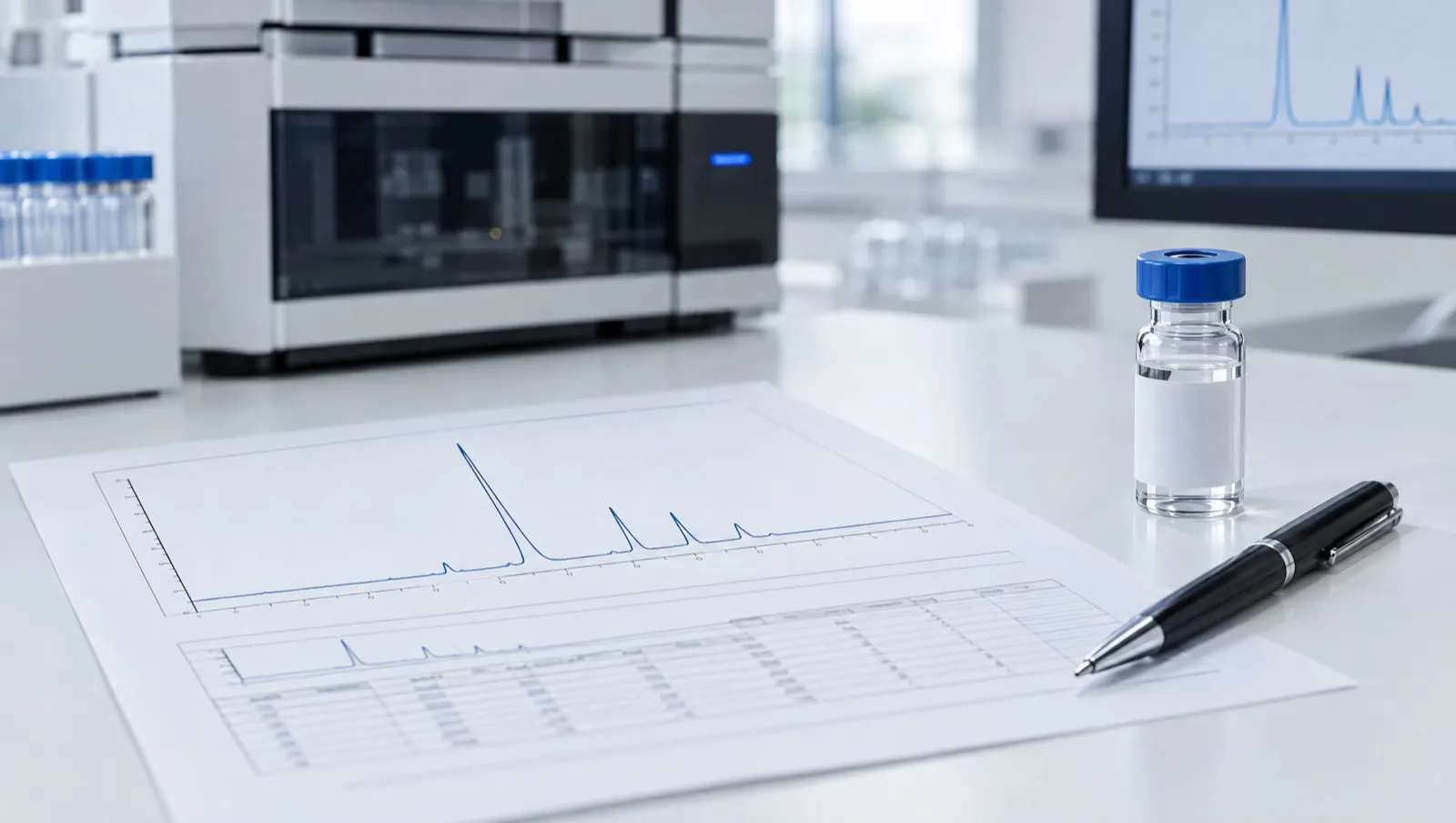
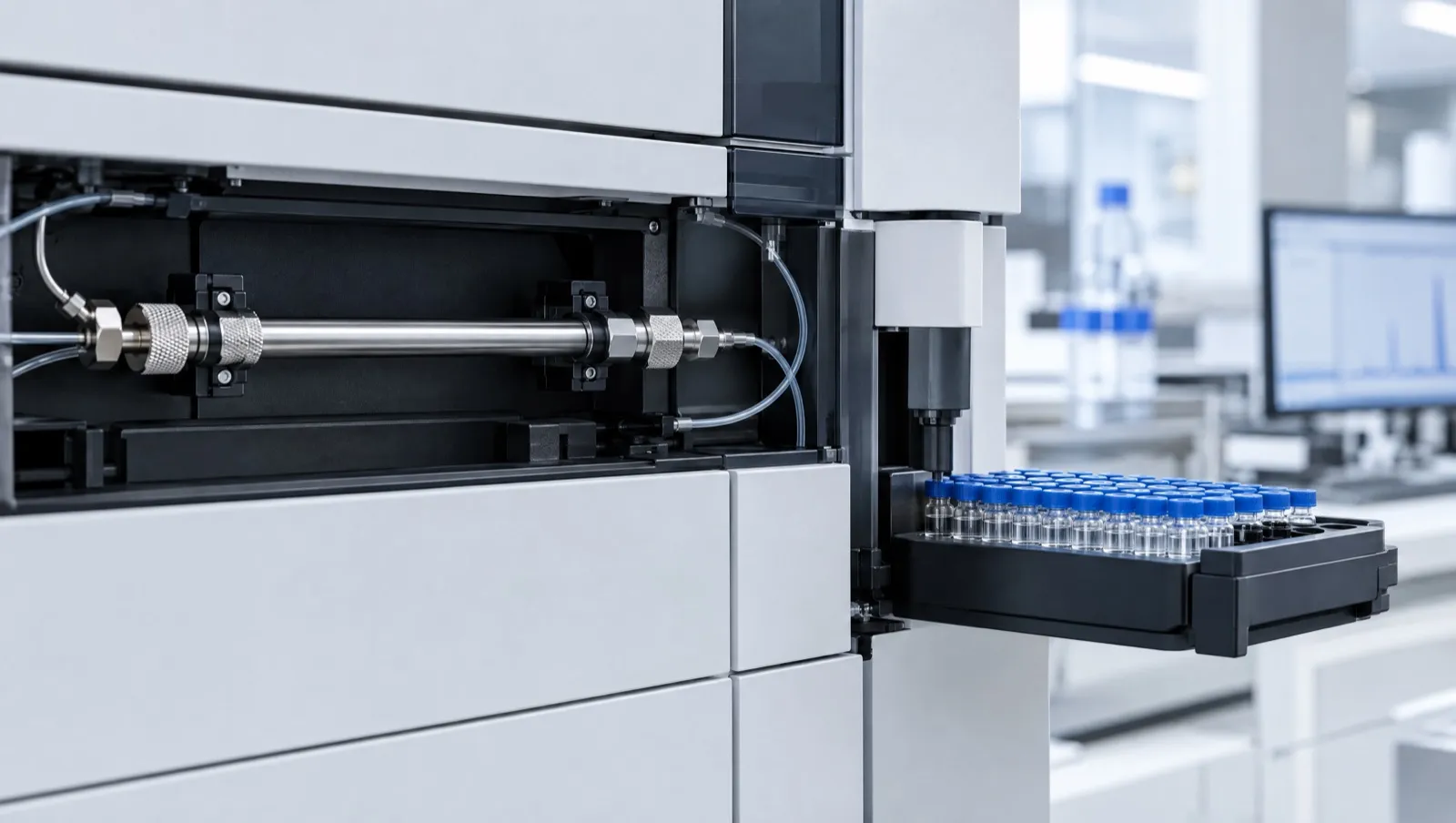
Purity should be measured by a method that separates the target peptide from related impurities, usually reversed-phase HPLC. The COA should state the method and attach the chromatogram, so the main peak and any impurity peaks can be seen [4, 5]. A purity figure with no method or chromatogram cannot be checked.
5. Is peptide content reported, not just purity?
Purity and quantity are different questions. A lyophilised powder also contains water and counter-ions, so a high-purity peptide can still hold more or less peptide than the label states [1, 8]. The semaglutide study above found products that were both far less pure and over-filled relative to their labels [1]. See Purity vs Peptide Content.
6. Are methods and specifications published?
International guidelines on specifications and analytical validation (ICH Q6B and ICH Q2(R2)) describe identity, purity, quantity and impurities as the core quality attributes, and expect methods to be fit for purpose [5, 9]. A good supplier states the method and the acceptance criterion next to each result, so “Pass” has a defined meaning.
7. Do the data look like real batch data?
Real analytical data vary. The same purity figure on every product, identical chromatograms across compounds, or a COA dated long before the material is sold are all reasons for caution. Peptides degrade over time, so test dates matter. See Lyophilised Peptides: Storage, Stability and Degradation.
8. Is contaminant testing reported where it is claimed?
Endotoxin, water content (for example by Karl Fischer titration) and counter-ion content are not on every research COA. Where a supplier makes claims about them, the claim should be backed by a batch result. Endotoxin was present in every semaglutide sample in the 2024 study [1], and an undeclared excipient was found in research peptides in the 2020 report [2].
Business checks (9–12)
9. Is it a contactable Australian business with an ABN?
An Australian Business Number (ABN) can be checked on the Australian Business Register’s public ABN Lookup, which lets anyone search by ABN or business name and see the registered entity and its status [10]. Check that the ABN is active and that the entity name matches the business. A street-level business address, a working phone number or email, and a named business entity are basic accountability signals.
10. Are policies transparent and complete?
Shipping times, dispatch locations, returns, privacy and how complaints are handled should be published in full and should match what the supplier says elsewhere. Vague or missing policies make it hard to resolve a problem with a batch.
11. Are storage and dispatch conditions consistent with peptide stability?
Peptide degradation through oxidation, deamidation and hydrolysis speeds up with temperature and moisture [11, 12]. A supplier should state how material is stored before dispatch (for example refrigerated or frozen, dry and dark) and how it is packed for transit. Claims of indefinite room-temperature stability are not consistent with the stability literature.
12. Is the framing honest and research-only, with no therapeutic claims?
Research materials sold in Australia are not included in the Australian Register of Therapeutic Goods (ARTG). The TGA notes that unapproved therapeutic goods have not been assessed for safety, quality or effectiveness [13]. Advertising of therapeutic goods to the public is governed by the Therapeutic Goods Advertising Code [14].
A supplier of research material should therefore:
- describe compounds by their research literature, not by promised effects;
- give no guidance on use in people or animals;
- avoid testimonials and lifestyle claims;
- avoid unsupported quality labels (for example, “medicine-equivalent” grade claims) unless it holds documents proving them.
Selling a compound as “research use only” while publishing human-use guidance is a contradiction, and a sign the rest of the documentation may not be reliable either. Labelling also does not change a compound’s legal status. See Are Peptides Legal in Australia?.
Red flags at a glance
- No COA, or a COA without a batch number
- A COA for a different size, compound or blend
- No laboratory name, or a laboratory that cannot be contacted
- Purity with no method or chromatogram; no mass spectrometry
- Identical purity figures across a whole catalogue
- No ABN, or an ABN that is cancelled or belongs to a different entity
- Any human-use instructions
- Claims that a compound has a therapeutic effect on any condition
What this means in Australia
ARTG. Research peptides are not entered on the Australian Register of Therapeutic Goods (ARTG). The TGA notes that unapproved therapeutic goods have not been assessed for safety, quality or effectiveness [13].
Poisons Standard. Status depends on the compound [15]. Several peptides sold for research, including BPC-157, TB-500, CJC-1295, ipamorelin, GHRP-2 and GHRP-6, are named in the current Poisons Standard (October 2026) in Schedule 4 and Appendix D, clause 5 [16]. Schedule 4 means prescription-only. Appendix D, clause 5 means possessing it without authority is illegal. Other peptides are not named, but not being named does not mean a substance is unregulated [16, 17].
TGA position. In April 2026 the TGA stated that a “research use only” disclaimer does not make supply lawful, and does not change a product’s regulatory status, permit importation, or remove advertising or supply obligations [17]. In June 2026 it added unapproved peptide products to its compliance priorities [18]. In July 2026 it said that advertising unapproved therapeutic goods to Australian consumers, including on websites, is generally unlawful, and that “manufacture” includes applying a label to a blank vial [19].
Testing laboratories. In Australia, NATA accredits testing laboratories to ISO/IEC 17025 [6]. A COA from an accredited laboratory is a quality signal. It does not change a product’s regulatory status. See Are Peptides Legal in Australia?.
This is general information, not legal advice. Laws change; check the current Poisons Standard and TGA guidance.
Frequently asked questions
What should I check before I buy research peptides in Australia?
Check for a batch-matched COA from a named independent laboratory, identity by mass spectrometry, HPLC purity with a chromatogram, and a reported peptide content. Then check the business: a valid ABN, published policies, stated storage conditions, and no therapeutic claims [1, 5, 10].
How can I tell if a peptide COA is genuine?
Match the batch number to the vial, confirm the report with the named laboratory, and check that the reported molecular mass matches the theoretical mass. See How to Read a Peptide COA.
Is a high purity figure enough?
No. Purity describes the peptide fraction only. Peptide content, identity and contaminants are separate questions, and published studies have found products with large discrepancies in each [1, 2].
Why does an ABN matter?
An ABN can be checked on the public ABN Lookup to confirm that a business is registered and active, and that its name matches [10]. It links the seller to an accountable legal entity.
Is it legal to buy research peptides in Australia?
It depends on the specific compound. Several peptides are named in the current Poisons Standard (October 2026) in Schedule 4 and Appendix D, clause 5, which means possessing them without authority is illegal, and research materials are not entered on the ARTG [13, 16]. The TGA states that a “research use only” label does not make supply lawful [17]. See Are Peptides Legal in Australia? This is general information, not legal advice.
References
- Ashraf AR, Mackey TK, Vida RG, et al. Multifactor quality and safety analysis of semaglutide products sold by online sellers without a prescription: market surveillance, content analysis, and product purchase evaluation study. J Med Internet Res. 2024;26:e65440. doi:10.2196/65440. PMID: 39509151
- Choules MP, Bisson J, Simmler C, et al. NMR reveals an undeclared constituent in custom synthetic peptides. J Pharm Biomed Anal. 2020;178:112915. doi:10.1016/j.jpba.2019.112915. PMID: 31671336
- Janvier S, De Spiegeleer B, Vanhee C, Deconinck E. Falsification of biotechnology drugs: current dangers and/or future disasters? J Pharm Biomed Anal. 2018;161:175–191. doi:10.1016/j.jpba.2018.08.037. PMID: 30165334
- D’Hondt M, Bracke N, Taevernier L, et al. Related impurities in peptide medicines. J Pharm Biomed Anal. 2014;101:2–30. doi:10.1016/j.jpba.2014.06.012. PMID: 25044089
- International Council for Harmonisation. ICH Q6B: Specifications: test procedures and acceptance criteria for biotechnological/biological products. database.ich.org. Accessed 11 October 2026.
- National Association of Testing Authorities, Australia (NATA). Accreditation programs, including ISO/IEC 17025 testing and calibration. nata.com.au. Accessed 11 October 2026.
- Krug O, Thomas A, Malerød-Fjeld H, et al. Analysis of new growth promoting black market products. Growth Horm IGF Res. 2018;41:1–6. doi:10.1016/j.ghir.2018.05.001. PMID: 29864719
- McCarthy D, Han Y, Carrick K, et al. Reference standards to support quality of synthetic peptide therapeutics. Pharm Res. 2023;40(6):1317–1328. doi:10.1007/s11095-023-03493-1. PMID: 36949371
- International Council for Harmonisation. ICH Q2(R2): Validation of analytical procedures. 2023. database.ich.org. Accessed 11 October 2026.
- Australian Business Register. ABN Lookup. abr.business.gov.au. Accessed 11 October 2026.
- Lai MC, Topp EM. Solid-state chemical stability of proteins and peptides. J Pharm Sci. 1999;88(5):489–500. doi:10.1021/js980374e. PMID: 10229638
- Manning MC, Chou DK, Murphy BM, Payne RW, Katayama DS. Stability of protein pharmaceuticals: an update. Pharm Res. 2010;27(4):544–575. doi:10.1007/s11095-009-0045-6. PMID: 20143256
- Therapeutic Goods Administration. Unapproved therapeutic goods. tga.gov.au/products/unapproved-therapeutic-goods. Accessed 11 October 2026.
- Therapeutic Goods (Therapeutic Goods Advertising Code) Instrument 2021. Federal Register of Legislation. legislation.gov.au/F2021L01661/latest/text. Accessed 11 October 2026.
- Therapeutic Goods Administration. The Poisons Standard and scheduling of medicines and chemicals. tga.gov.au. Accessed 11 October 2026.
- Therapeutic Goods (Poisons Standard—October 2026) Instrument 2026 (F2026L01327). Federal Register of Legislation. legislation.gov.au/F2026L01327/latest/text. Accessed 11 October 2026.
- Therapeutic Goods Administration. Understanding your responsibilities when importing, compounding and supplying unapproved peptide products. Safety advisory, 13 April 2026. tga.gov.au. Accessed 11 October 2026.
- Therapeutic Goods Administration. TGA strengthens compliance focus on unapproved peptide products as part of evolving risk response. Media release, 10 June 2026. tga.gov.au. Accessed 11 October 2026.
- Therapeutic Goods Administration. Unapproved peptide product promoters and suppliers are put on notice. Media release, 20 July 2026. tga.gov.au. Accessed 11 October 2026.
Important information and disclaimer
General information only. This article is published for general educational and informational purposes. It summarises published scientific literature and public regulatory information as at the “last reviewed” date shown above. It is not medical, health, pharmaceutical, veterinary or legal advice, and it must not be relied on as a substitute for advice from a qualified professional about your circumstances.
Not for human or animal use. Nothing in this article recommends, endorses or describes the use of any substance in humans or animals. Findings from cell, animal or early human studies cannot be assumed to apply to people. The compounds discussed have not been evaluated by the Therapeutic Goods Administration (TGA) for safety, quality or efficacy unless the article expressly states otherwise. Any research materials offered by Iconic Peptides are supplied solely for in vitro and laboratory research.
No therapeutic claims. Iconic Peptides makes no claim that any product treats, cures, prevents, alleviates or diagnoses any disease, condition or symptom. References to published studies, clinical trials or medicines approved by regulators are factual descriptions of the scientific and regulatory record. They are not representations about any product we supply.
Regulatory status. Many peptides are scheduled substances under the Poisons Standard. Some are prescription-only (Schedule 4), and some may not be possessed without authority (Appendix D). The TGA has stated that a “research use only” label does not make supply lawful, change a product’s regulatory status, or remove advertising or supply obligations. State and territory laws may also apply. You are responsible for knowing and complying with all laws that apply to you. Regulatory information in this article may change after the review date.
Accuracy and third-party sources. We take care to cite and verify every source, but we do not warrant that this article is complete, current or error-free. Citing a study or organisation does not mean that its authors or that organisation endorse Iconic Peptides.
Limitation of liability. To the maximum extent permitted by law, Iconic Peptides, its owners, employees and contributors exclude all liability for any loss, damage, injury or expense, whether direct, indirect or consequential, arising from use of or reliance on this article or any misuse of any product. Nothing in this disclaimer excludes, restricts or modifies any right or remedy under the Australian Consumer Law that cannot lawfully be excluded.
Age restriction. This website is intended for adults aged 18 and over.