In plain English
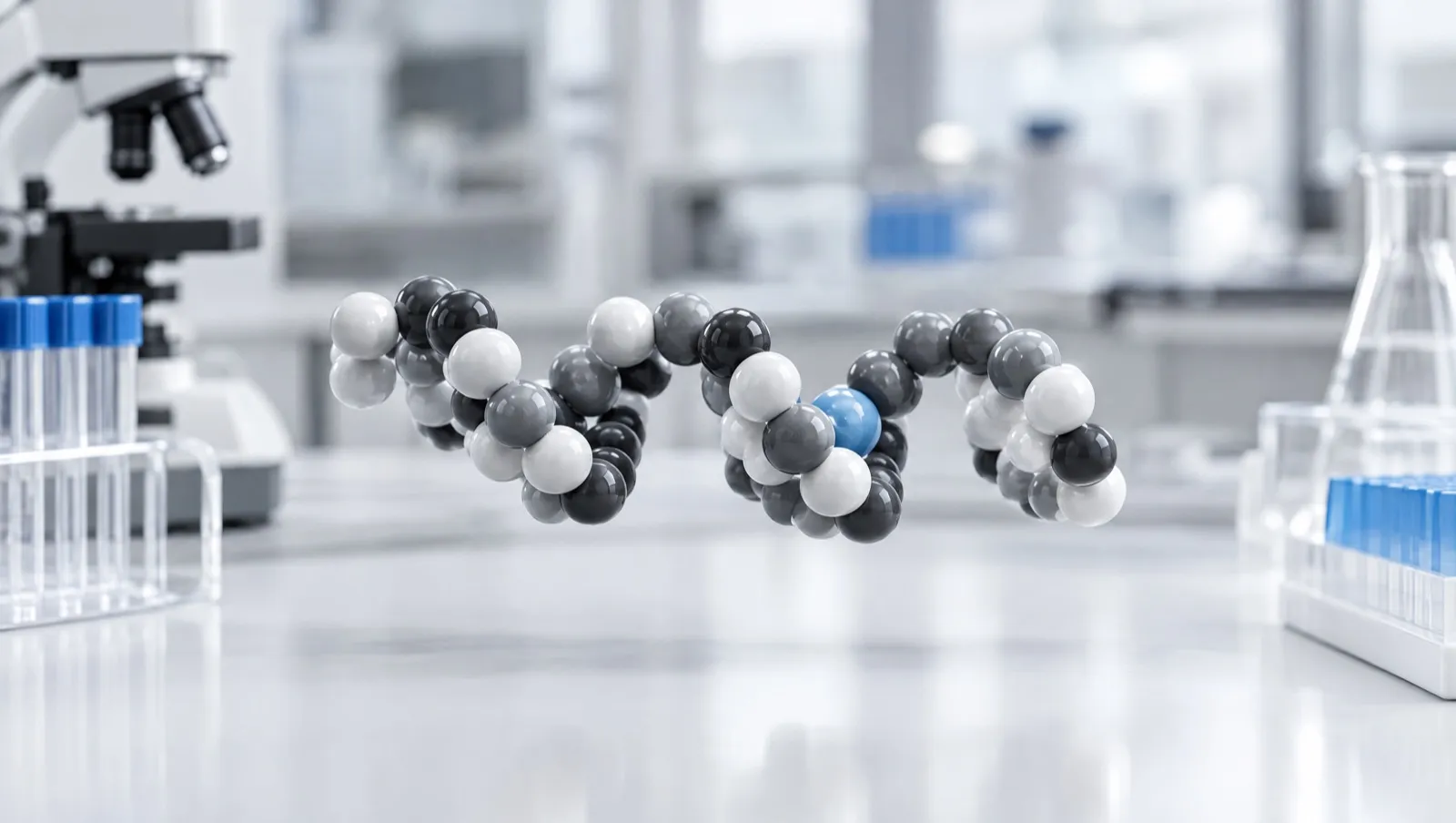
Peptides are short chains of amino acids (the building blocks of proteins). About 125 years ago, chemists were not sure how proteins were built. Emil Fischer guessed that amino acids were joined by a particular link, now called the peptide bond. In 1901 he and a colleague made and studied one of the simplest peptides, glycylglycine [2].
Over the next century, scientists found that many hormones (chemical messengers) are peptides. Insulin was the most famous, first extracted in Canada in 1921–22 [5]. Chemists then learned to read the order of amino acids in a peptide, and to build peptides from scratch [2, 8].
The big leap came in 1963, when Bruce Merrifield showed peptides could be built on tiny resin beads, one amino acid at a time. This made synthesis much faster [2, 10]. Later, scientists used engineered bacteria to make human insulin [13].
This article covers milestones only. Each one is backed by a cited source.
The short version
- Fischer’s 1901 paper is seen as the start of peptide chemistry [2].
- Insulin was isolated in 1921–22 and won a Nobel Prize in 1923 [5, 6].
- Solid-phase synthesis (1963) made peptides far easier to make [2, 10].
Timeline of key milestones
| Year | Milestone | Source |
|---|---|---|
| 1901 | Emil Fischer and Ernest Fourneau publish work on glycylglycine and related derivatives, regarded as the beginning of peptide synthetic chemistry | [1, 2] |
| 1902 | William Bayliss and Ernest Starling describe secretin, a gut hormone | [3, 4] |
| 1921–22 | Frederick Banting and Charles Best prepare an active pancreatic extract (1921); James Collip purifies insulin (1922) | [5] |
| 1923 | Nobel Prize in Physiology or Medicine to Banting and John Macleod “for the discovery of insulin” | [6] |
| 1932 | Max Bergmann and Leonidas Zervas introduce the benzyloxycarbonyl (Z) protecting group | [2] |
| 1953 | Vincent du Vigneaud’s team synthesises oxytocin, a 9-residue peptide hormone | [2, 7] |
| 1955 | Nobel Prize in Chemistry to du Vigneaud, including “the first synthesis of a polypeptide hormone” | [8] |
| 1955 | Frederick Sanger’s group reports the disulphide bonds of insulin | [9] |
| 1958 | Nobel Prize in Chemistry to Sanger “for his work on the structure of proteins, especially that of insulin” | [10] |
| 1963 | R. Bruce Merrifield publishes solid-phase peptide synthesis (SPPS); the 39-residue hormone corticotropin is also synthesised | [2, 11] |
| 1965 | Total synthesis and crystallisation of bovine insulin | [2] |
| 1977 | Nobel Prize to Roger Guillemin and Andrew Schally for peptide hormones of the brain, and to Rosalyn Yalow for radioimmunoassays of peptide hormones | [12] |
| 1978 | First recombinant DNA human insulin prepared from A- and B-chains expressed in E. coli | [13] |
| 1982 | First insulin products made by recombinant DNA technology are marketed | [13] |
| 1984 | Nobel Prize in Chemistry to Merrifield for chemical synthesis on a solid matrix | [14] |
| 1994 | Native chemical ligation lets unprotected peptide segments be joined into full-size proteins | [15] |
1901: Fischer and the peptide bond
At the turn of the 20th century, chemists suspected but had not proved that proteins were chains of amino acids. Emil Fischer entered protein chemistry in 1899 and approached the question by synthesis. His work rested on the assumption that amino acids are linked by amide bonds, which we now call peptide bonds [2].
Fischer partially hydrolysed the cyclic form of glycine (a diketopiperazine) to obtain glycylglycine, a dipeptide, then prepared and characterised its derivatives. He and Ernest Fourneau published these findings in 1901 [1, 2]. That paper is regarded as the start of peptide synthetic chemistry [2]. In this early period, peptide synthesis was mainly seen as a way to test the theory that proteins are polypeptides [16].
1902–1923: peptide hormones and insulin
In 1902, Bayliss and Starling described secretin, a substance from the gut that stimulates pancreatic secretion [3, 4]. Over the following century secretin was purified, its structure determined, and it was chemically synthesised [4].
Insulin became the defining peptide of the era. In October 1920 Frederick Banting, a surgeon in London, Ontario, conceived the idea of isolating the internal secretion of the pancreas. He then met John Macleod in Toronto, and together they developed a research plan. Banting and his student assistant Charles Best prepared an active extract from a canine pancreas by August 1921. In January 1922, the biochemist James Collip isolated insulin pure enough for human use [5]. Banting and Macleod received the 1923 Nobel Prize in Physiology or Medicine “for the discovery of insulin” [6].
1930s–1950s: protecting groups and the first synthetic hormone
Making longer peptides required a way to stop amino acids reacting in the wrong places. In 1932 Max Bergmann and Leonidas Zervas, students of Fischer, introduced the benzyloxycarbonyl (Z) group, a protecting group for amino groups that could be added and removed under mild conditions. Reviews describe it as laying the groundwork for modern peptide synthesis [2].
In 1953, Vincent du Vigneaud and colleagues reported the synthesis of an octapeptide amide with the hormonal activity of oxytocin [7]. The 1953 paper described the product as an octapeptide amide; recent reviews describe oxytocin as a 9-residue peptide amide [2, 7]. Du Vigneaud received the 1955 Nobel Prize in Chemistry, cited in part “for the first synthesis of a polypeptide hormone” [8].
1950s: reading the sequence
Synthesis needs a target sequence. Through the 1950s, methods for sequence analysis developed by Pehr Edman and Frederick Sanger allowed the amino acid sequences of bioactive peptides to be worked out one after another [2]. In 1955, Sanger’s group reported the disulphide bonds of insulin, the cross-links that join its two chains [9]. Sanger received the 1958 Nobel Prize in Chemistry “for his work on the structure of proteins, especially that of insulin” [10].
With exact sequences known, peptide chemistry gained clear targets. Total synthesis of peptide hormones and antibiotics became possible, providing material for studying how structure relates to biological activity [16].
1963: solid-phase peptide synthesis
Solution-phase synthesis of long peptides demanded great skill and time [2]. In 1963, R. Bruce Merrifield published “Solid Phase Peptide Synthesis. I. The Synthesis of a Tetrapeptide” [11].
The idea was simple and powerful [2]:
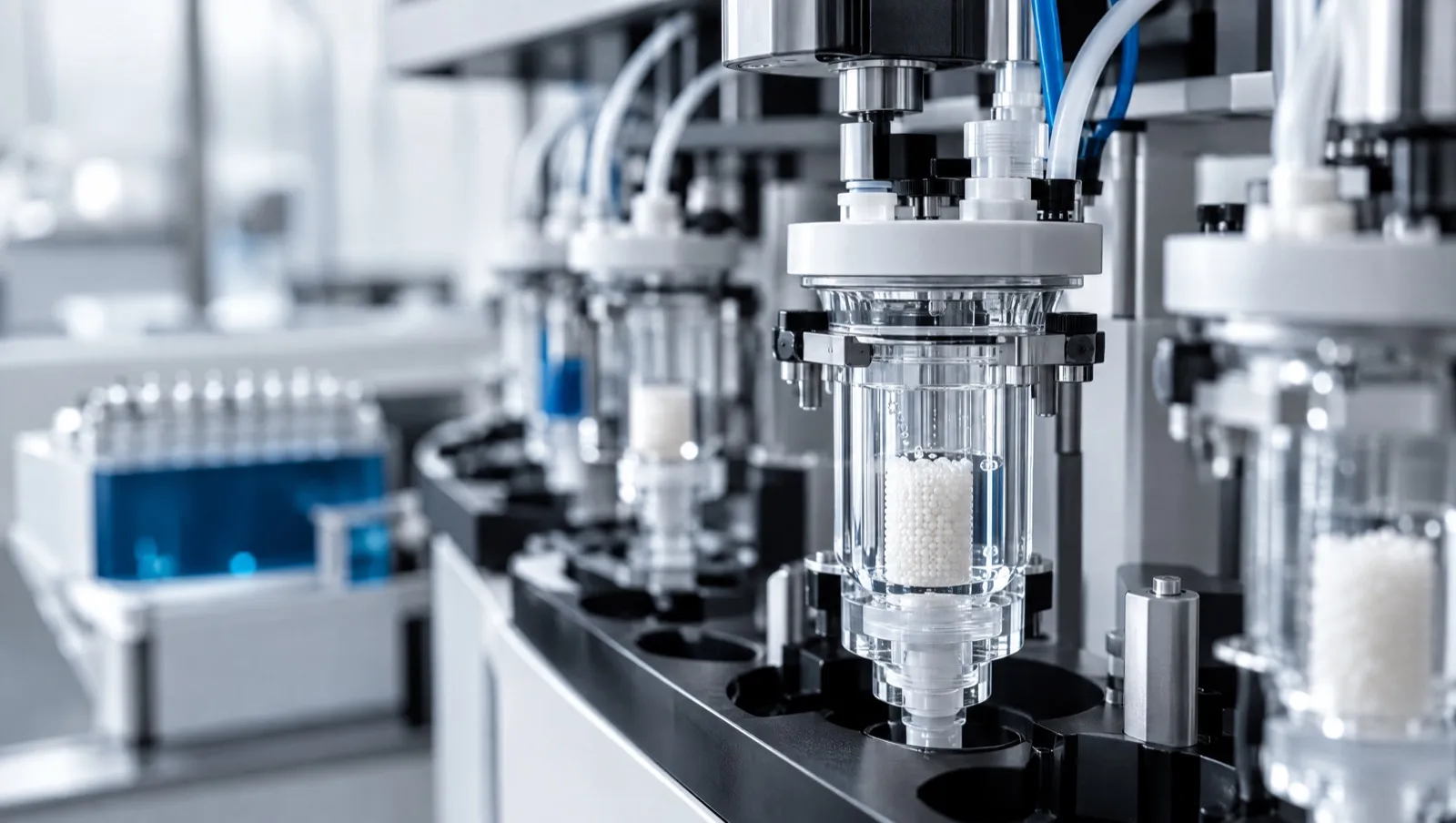
- Anchor the first protected amino acid (the C-terminal one) to a bead of cross-linked polystyrene resin.
- Remove the amino-protecting group.
- Add an excess of the next protected amino acid with a coupling reagent to form a peptide bond.
- Wash away excess reagents, since the growing chain stays attached to the bead.
- Repeat, building the chain from the C-terminus to the N-terminus, then release the finished peptide from the resin with acid.
Because each cycle is just “react, then wash”, target peptides could be made rapidly by repeating a simple operation [2]. Merrifield received the 1984 Nobel Prize in Chemistry “for his development of methodology for chemical synthesis on a solid matrix” [14]. A first-hand account by his first graduate student describes solid-phase synthesis as a paradigm shift for chemistry [17]. For how SPPS works today, see How Peptides Are Made.
SPPS was soon pushed towards proteins. In 1971 Gutte and Merrifield synthesised bovine ribonuclease A (124 amino acids), obtaining material with 78% of the natural enzyme’s activity. In 1988 Schneider and Kent synthesised the 99-residue HIV-1 protease, which was enzymatically active [2].
1970s: peptide hormones of the brain
The 1977 Nobel Prize in Physiology or Medicine recognised two strands of peptide science. Roger Guillemin and Andrew Schally were honoured “for their discoveries concerning the peptide hormone production of the brain”, and Rosalyn Yalow “for the development of radioimmunoassays of peptide hormones” [12]. The growth hormone story is told in The Growth Hormone Axis Explained.
1978–1982: recombinant DNA
Insulin had been extracted from animal pancreas for decades. In 1978, David Goeddel and colleagues at Genentech prepared the first recombinant DNA human insulin, by expressing the insulin A- and B-chains in Escherichia coli and combining them. In 1982, the first insulin products made with recombinant DNA technology were marketed [13]. Recombinant technology has since provided a potentially unlimited source of insulin and allowed engineered insulin analogues [18].
1994 onwards: ligation and modern peptide medicines
SPPS works best for chains of modest length. In 1994, Dawson, Muir, Clark-Lewis and Kent described native chemical ligation: two unprotected peptide segments react to form a thioester-linked intermediate, which rearranges spontaneously to give a native peptide bond at the join. They used it to make a cytokine with several disulfide bonds in one step [15].
Peptide medicines have been part of medical practice since insulin in the 1920s [19]. By 2018 more than 60 peptide drugs were approved in the United States and other major markets [19], and a 2021 review counted more than 80 that had reached the market worldwide [20]. Discovery has broadened from human hormones to peptides from venoms and other natural sources, and to display libraries [20]. For how a modern peptide medicine reaches approval, see How Peptide Medicines Are Developed.
What this means in Australia
Approval is a modern gatekeeper. Many of the early peptide medicines described above were introduced long before today’s regulatory systems. In Australia, a medicine must now be evaluated by the TGA and included on the Australian Register of Therapeutic Goods (ARTG). Peptide products that are not on the ARTG are unapproved therapeutic goods [21].
History does not change scheduling. A peptide’s long history, or the fact that it has been made for decades, does not change its legal status. The Poisons Standard (October 2026) names a number of peptides. Oxytocin, for example, is in Schedule 4 (prescription-only) [22]. Other peptides are not named, and not being named does not mean a substance is unregulated [21, 22].
“Research use only” labels. In April 2026 the TGA stated that a “research use only” disclaimer does not make supply lawful, and does not change a product’s regulatory status, permit importation, or remove advertising or supply obligations [21]. See Are Peptides Legal in Australia?.
This is general information, not legal advice. Laws change; check the current Poisons Standard and TGA guidance.
Frequently asked questions
Who discovered peptides?
No single person. Emil Fischer and Ernest Fourneau’s 1901 paper on glycylglycine is regarded as the beginning of peptide synthetic chemistry, and Fischer’s work assumed that amino acids are joined by peptide (amide) bonds [1, 2].
When was insulin discovered?
Banting and Best prepared an active pancreatic extract in 1921, and Collip purified insulin in January 1922. Banting and Macleod received the 1923 Nobel Prize [5, 6].
What was the first peptide hormone to be synthesised?
Oxytocin. Vincent du Vigneaud’s group reported its synthesis in 1953, and he received the 1955 Nobel Prize in Chemistry [7, 8].
Who invented solid-phase peptide synthesis?
R. Bruce Merrifield, who published the method in 1963 and received the 1984 Nobel Prize in Chemistry [11, 14].
When was recombinant human insulin first made?
Recombinant human insulin was first prepared in 1978, and the first recombinant insulin products were marketed in 1982 [13].
References
- Fischer E, Fourneau E. Ueber einige Derivate des Glykocolls. Ber Dtsch Chem Ges. 1901;34(2):2868–2877. doi:10.1002/cber.190103402249
- Aimoto S, Kawakami T, Hojo H. Development of protein chemical synthesis using peptide thioester synthetic blocks. Proc Jpn Acad Ser B Phys Biol Sci. 2025;101(10):622–647. doi:10.2183/pjab.101.034. PMID: 41371639
- Bayliss WM, Starling EH. The mechanism of pancreatic secretion. J Physiol. 1902;28(5):325–353. doi:10.1113/jphysiol.1902.sp000920. PMID: 16992627
- Chey WY, Chang TM. Secretin, 100 years later. J Gastroenterol. 2003;38(11):1025–1035. doi:10.1007/s00535-003-1235-3. PMID: 14673718
- Hegele RA, Maltman GM. Insulin’s centenary: the birth of an idea. Lancet Diabetes Endocrinol. 2020;8(12):971–977. doi:10.1016/S2213-8587(20)30337-5. PMID: 33129375
- Nobel Prize Outreach. The Nobel Prize in Physiology or Medicine 1923: summary (Frederick Grant Banting and John James Rickard Macleod). nobelprize.org. Accessed 11 October 2026.
- du Vigneaud V, Ressler C, Swan JM, et al. The synthesis of an octapeptide amide with the hormonal activity of oxytocin. J Am Chem Soc. 1953;75(19):4879–4880. doi:10.1021/ja01115a553
- Nobel Prize Outreach. The Nobel Prize in Chemistry 1955: summary (Vincent du Vigneaud). nobelprize.org. Accessed 11 October 2026.
- RYLE AP, SANGER F, SMITH LF, KITAI R. The disulphide bonds of insulin. Biochem J. 1955;60(4):541–556. doi:10.1042/bj0600541. PMID: 13249947
- Nobel Prize Outreach. The Nobel Prize in Chemistry 1958: summary (Frederick Sanger). nobelprize.org. Accessed 11 October 2026.
- Merrifield RB. Solid phase peptide synthesis. I. The synthesis of a tetrapeptide. J Am Chem Soc. 1963;85(14):2149–2154. doi:10.1021/ja00897a025
- Nobel Prize Outreach. The Nobel Prize in Physiology or Medicine 1977: summary (Roger Guillemin, Andrew V. Schally and Rosalyn Yalow). nobelprize.org. Accessed 11 October 2026.
- Quianzon CC, Cheikh I. History of insulin. J Community Hosp Intern Med Perspect. 2012;2(2):18701. doi:10.3402/jchimp.v2i2.18701. PMID: 23882369
- Nobel Prize Outreach. The Nobel Prize in Chemistry 1984: summary (Robert Bruce Merrifield). nobelprize.org. Accessed 11 October 2026.
- Dawson PE, Muir TW, Clark-Lewis I, Kent SB. Synthesis of proteins by native chemical ligation. Science. 1994;266(5186):776–779. doi:10.1126/science.7973629. PMID: 7973629
- Ivanov VT, Blishchenko EY, Sazonova OV, Karelin AA. What to synthesize? From Emil Fischer to peptidomics. J Pept Sci. 2003;9(9):553–562. doi:10.1002/psc.480. PMID: 14552418
- Marshall GR. Solid-phase synthesis: a paradigm shift. J Pept Sci. 2003;9(9):534–544. doi:10.1002/psc.478. PMID: 14552416
- Owens DR, Monnier L, Ceriello A, Bolli GB. Insulin Centennial: Milestones influencing the development of insulin preparations since 1922. Diabetes Obes Metab. 2022;24 Suppl 1:27–42. doi:10.1111/dom.14587. PMID: 34708913
- Lau JL, Dunn MK. Therapeutic peptides: Historical perspectives, current development trends, and future directions. Bioorg Med Chem. 2018;26(10):2700–2707. doi:10.1016/j.bmc.2017.06.052. PMID: 28720325
- Muttenthaler M, King GF, Adams DJ, Alewood PF. Trends in peptide drug discovery. Nat Rev Drug Discov. 2021;20(4):309–325. doi:10.1038/s41573-020-00135-8. PMID: 33536635
- Therapeutic Goods Administration. Understanding your responsibilities when importing, compounding and supplying unapproved peptide products. Safety advisory, 13 April 2026. tga.gov.au. Accessed 11 October 2026.
- Therapeutic Goods (Poisons Standard—October 2026) Instrument 2026 (F2026L01327). Federal Register of Legislation. legislation.gov.au/F2026L01327/latest/text. Accessed 11 October 2026.
Important information and disclaimer
General information only. This article is published for general educational and informational purposes. It summarises published scientific literature and public regulatory information as at the “last reviewed” date shown above. It is not medical, health, pharmaceutical, veterinary or legal advice, and it must not be relied on as a substitute for advice from a qualified professional about your circumstances.
Not for human or animal use. Nothing in this article recommends, endorses or describes the use of any substance in humans or animals. Findings from cell, animal or early human studies cannot be assumed to apply to people. The compounds discussed have not been evaluated by the Therapeutic Goods Administration (TGA) for safety, quality or efficacy unless the article expressly states otherwise. Any research materials offered by Iconic Peptides are supplied solely for in vitro and laboratory research.
No therapeutic claims. Iconic Peptides makes no claim that any product treats, cures, prevents, alleviates or diagnoses any disease, condition or symptom. References to published studies, clinical trials or medicines approved by regulators are factual descriptions of the scientific and regulatory record. They are not representations about any product we supply.
Regulatory status. Many peptides are scheduled substances under the Poisons Standard. Some are prescription-only (Schedule 4), and some may not be possessed without authority (Appendix D). The TGA has stated that a “research use only” label does not make supply lawful, change a product’s regulatory status, or remove advertising or supply obligations. State and territory laws may also apply. You are responsible for knowing and complying with all laws that apply to you. Regulatory information in this article may change after the review date.
Accuracy and third-party sources. We take care to cite and verify every source, but we do not warrant that this article is complete, current or error-free. Citing a study or organisation does not mean that its authors or that organisation endorse Iconic Peptides.
Limitation of liability. To the maximum extent permitted by law, Iconic Peptides, its owners, employees and contributors exclude all liability for any loss, damage, injury or expense, whether direct, indirect or consequential, arising from use of or reliance on this article or any misuse of any product. Nothing in this disclaimer excludes, restricts or modifies any right or remedy under the Australian Consumer Law that cannot lawfully be excluded.
Age restriction. This website is intended for adults aged 18 and over.